

Greetings, Alchemists!
A few updates ago, a mechanic was introduced that has been celebrated by almost every player: Trait Selection during egg incubation. Since several months have passed since its inclusion and several matches have concluded, we can now study it properly.
In this post, we are going to analyze the general trait selection preferences of all players. Through this analysis, we can define which traits are the most selected, though this does not necessarily mean they are objectively the best.
Index
- Data Source
- Global Ranking
- Common Ranking
- Uncommon Ranking
- Rare Ranking
- Epic Ranking
- Unique Ranking
- Rarity Drop Rates
- Conclusion
1. Data Source
The matches included in this study are: "Machanguito Jam", "True Tryhards", "Partida Diminuta", and "Masacre Locotrona".
These are matches that started and ended AFTER the update that implemented the tracking of player trait selections. Additionally, two of these are "Masacre" (Slaughter) type matches—where all players start in the same region, leading to very fast-paced games. On the other hand, "Machanguito Jam" and "True Tryhards" are more standard matches, featuring one or more players per region across multiple regions, including neutral territories.
We had to exclude two matches: "Manusacre (Ahora si) 2" and "Nuevitos y Tranquilitos". Since the trait selection mechanic was introduced after these games had already begun, including them could distort the data, especially since Egg Genius (Genialidad) increases as turns progress.
2. Global Ranking
We have several ways to establish a ranking for trait selection. For this analysis, we will use three methods: Selection Count, Selection Percentage, and finally, an ELO-based ranking.
2.1 Global Ranking - Selection Count
We will begin with the most straightforward approach: the total number of times a specific trait is selected.
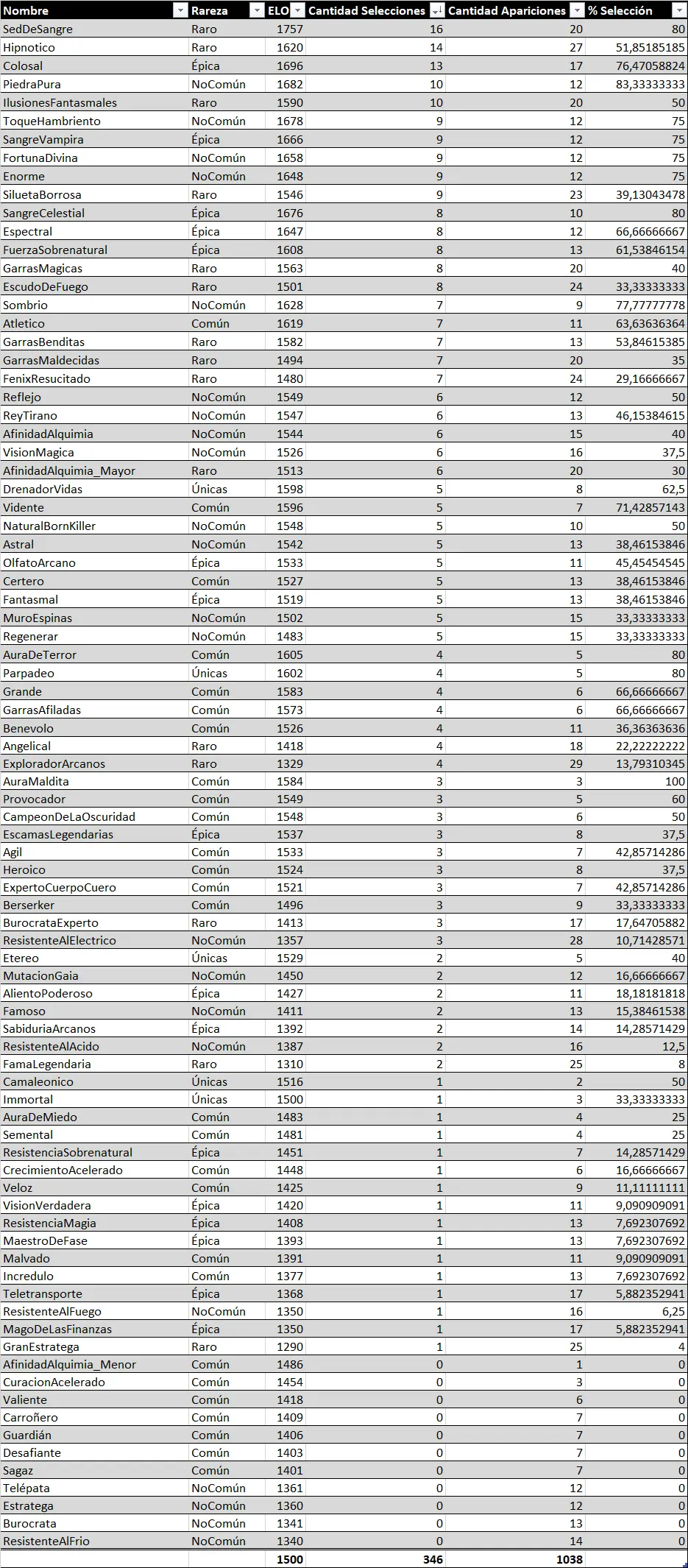
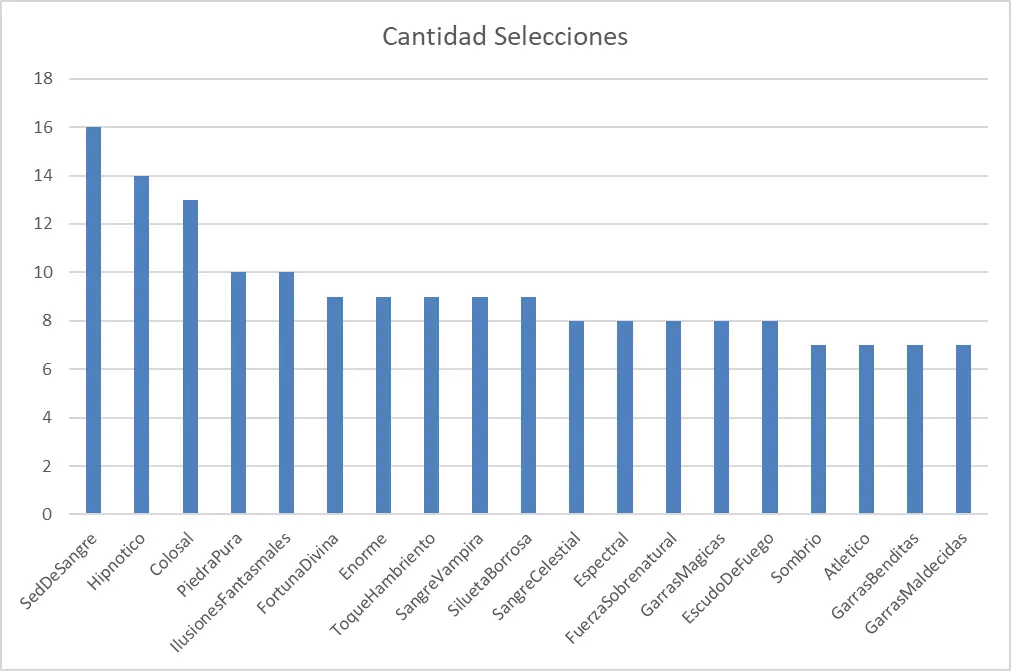 * Graphical representation of the top 20 most selected traits.
This method of measurement is not entirely reliable because it favors traits that appear frequently due to the luck of the draw.
To give a practical real-world example, take the cases of Pure Stone and Phantom Illusions.

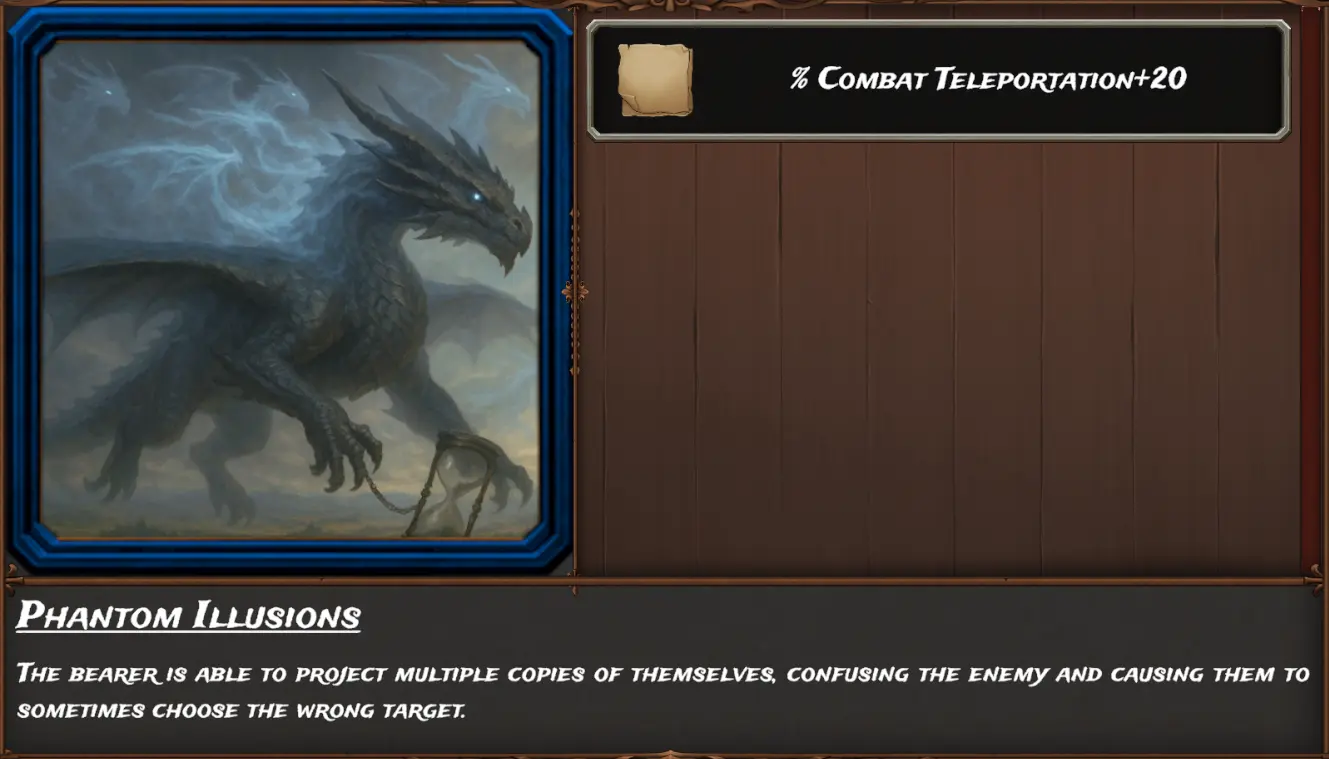
Both traits were selected by players a total of 10 times. This might lead us to think they are of similar power levels, but that is not the case. If we look at the appearance frequency... we see that "Pure Stone" appeared 12 times, whereas "Phantom Illusions" appeared a total of 20 times.
From this, we can easily realize that "Pure Stone" is much more popular than "Phantom Illusions". This discrepancy is exactly why we need the next section: Selection Percentage.
2.2 Global Ranking - Selection Percentage
Now, we will conduct our study by measuring the Selection Percentage. To do this, we take the number of times a trait was selected and divide it by the total number of times it appeared as an option.
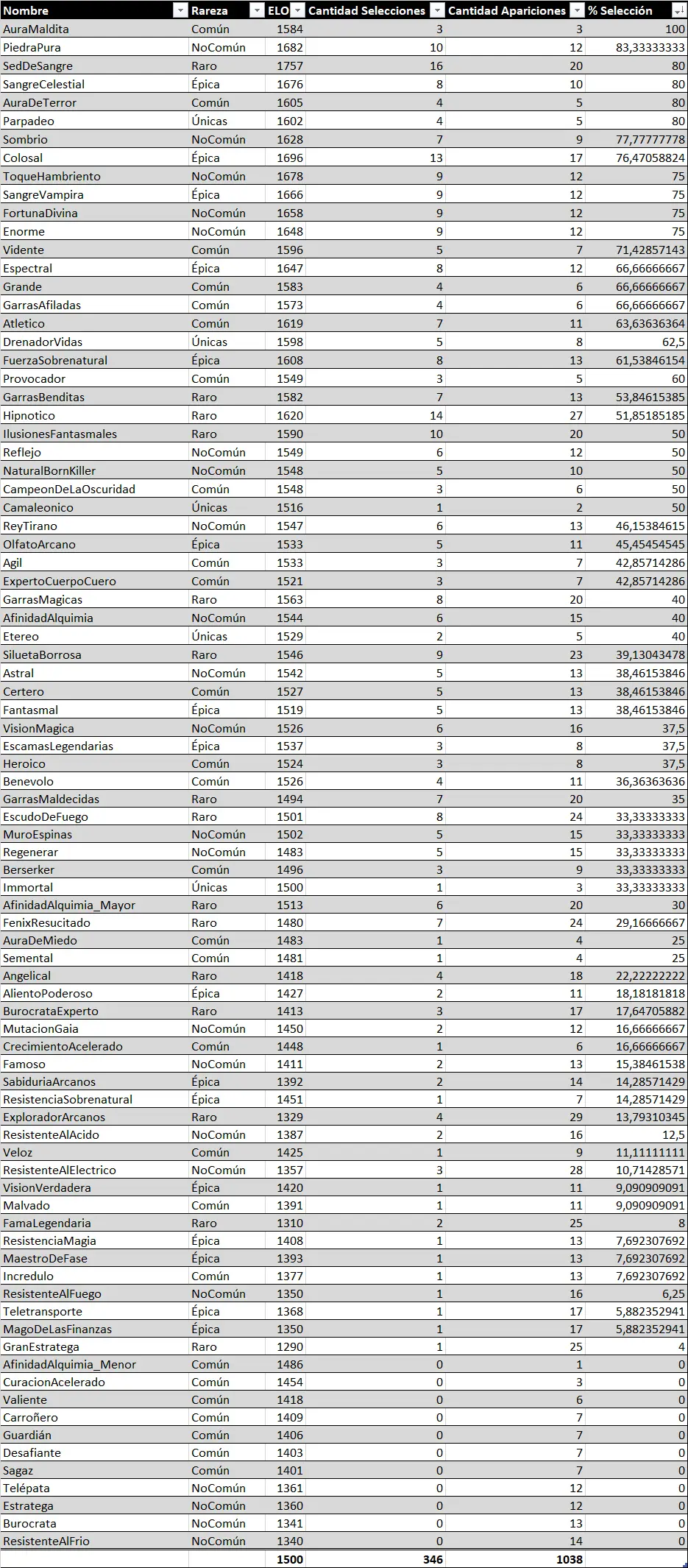
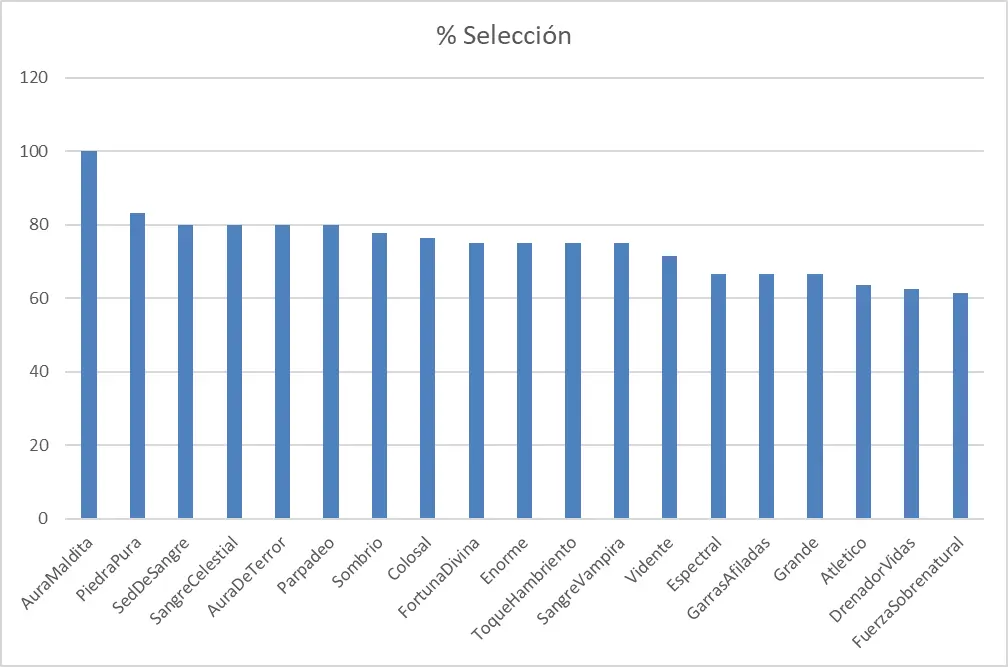 * Top 20 Traits by Selection Percentage
This measurement method seems more reliable than the previous one, but if we stop to think about it... in a way, it also favors those traits that have appeared only a few times but were selected every time they did. To give a practical real-world example, we have the cases of "Cursed Aura" and "Celestial Blood".
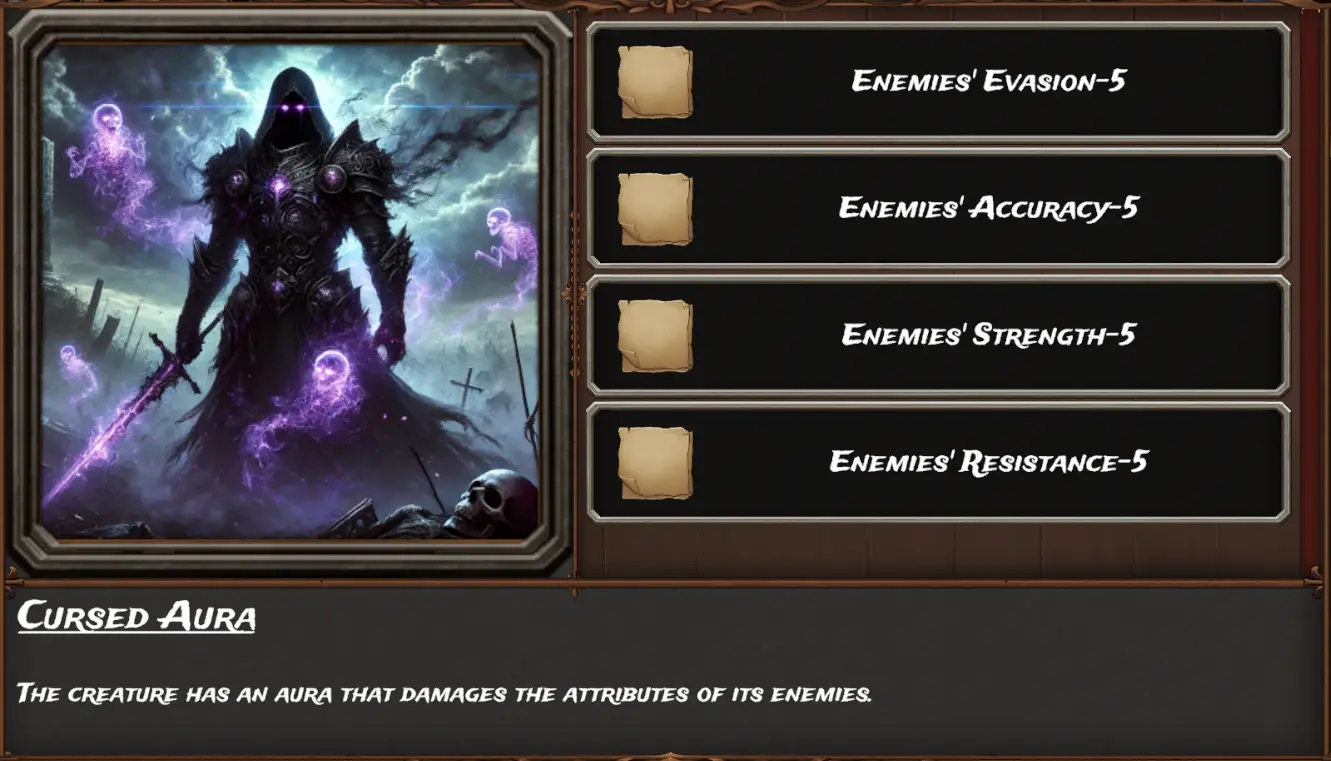
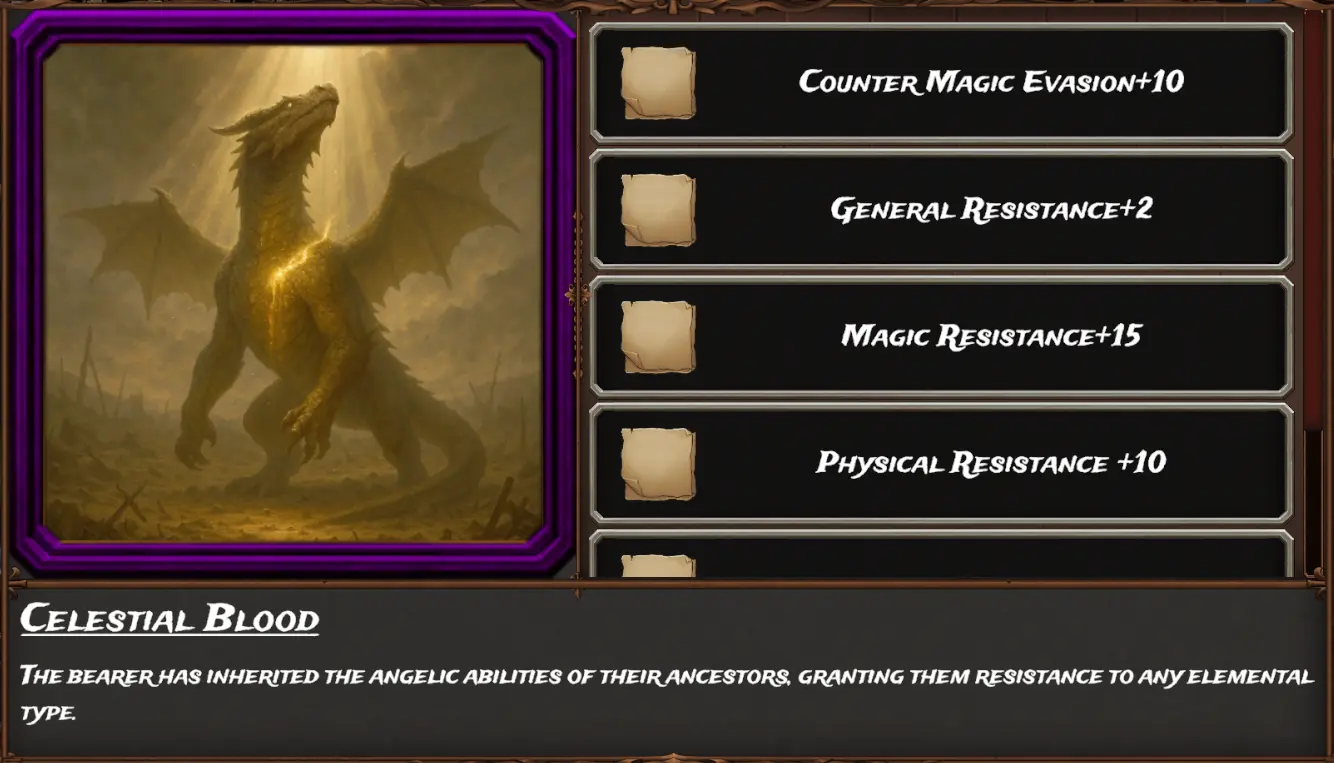
"Cursed Aura" has only appeared 3 times, and all 3 times it appeared, it was chosen, giving it a 100% selection rate. However, "Celestial Blood", despite being clearly superior, appeared 10 times and was chosen a total of 8 times. In other words, we need to be able to measure not just how many times a trait is selected, but also how much it is preferred over others.
To compensate for this gap, we have the following method for measuring a trait's quality: The ELO Ranking.
2.3 Global Ranking - ELO
For those who are not yet familiar with this system we use in Master of Cladia, it is the same system used in Chess and other competitive games to measure "how good someone or something is". If you enjoy math, I’ll leave this link here for you to geek out on.
Basically, the system assigns a score to each individual. When one defeats another, they gain or lose points based on the rating difference between them. The higher your opponent's ELO is compared to yours, the more points you gain if you win and the fewer you lose if you're defeated.
In this case, every time a trait is selected over two others, it’s as if that trait "won" against those other two. Since ELO typically only handles 1v1 matchups, we have processed it so that the selected trait "defeats" the others in descending ELO order.
That is: if trait A is selected, we check the ELO of the other options, B and C. Then, B and C are sorted so that the one with the highest ELO loses to A "first"; then, after that calculation, the second one "loses". If this isn't quite clear, I invite you to ask in the comments! 😁
Without further ado, here is the ELO-based ranking:
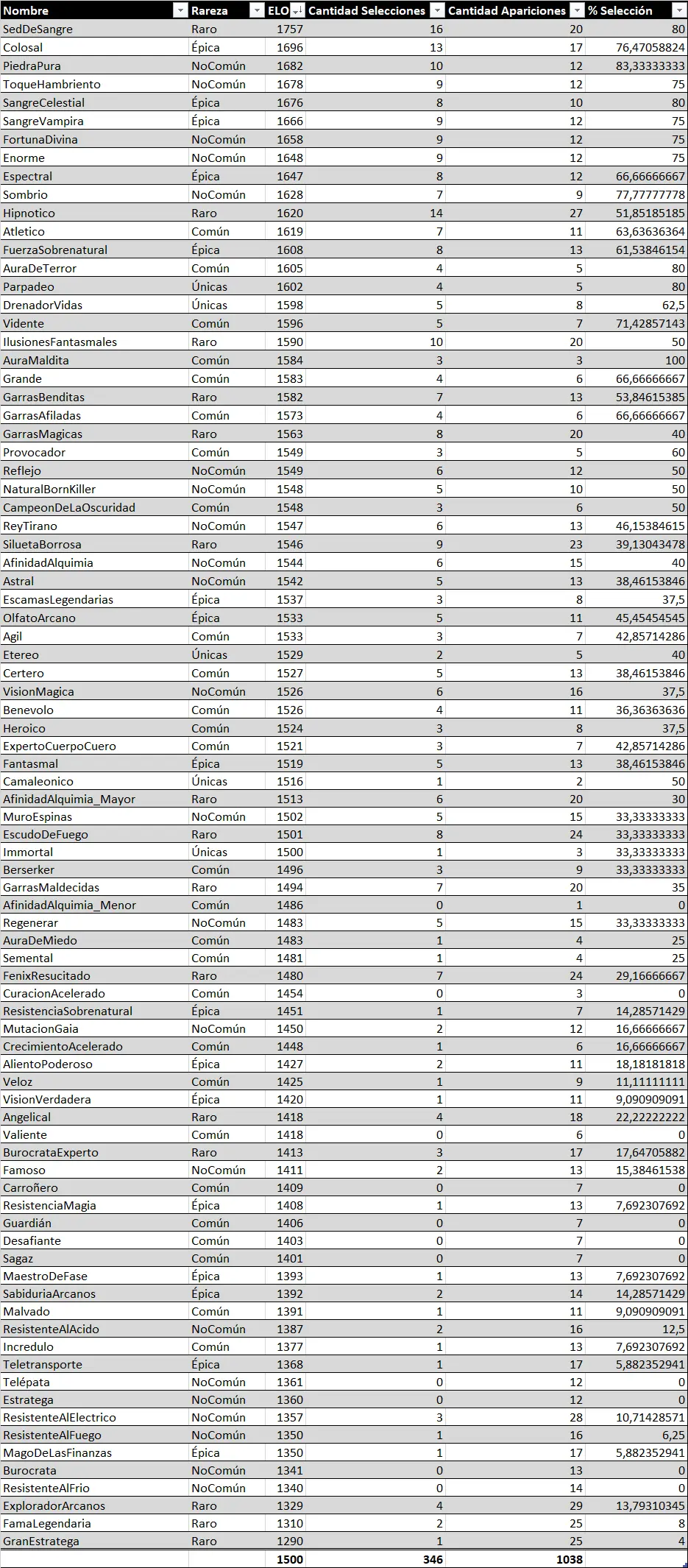
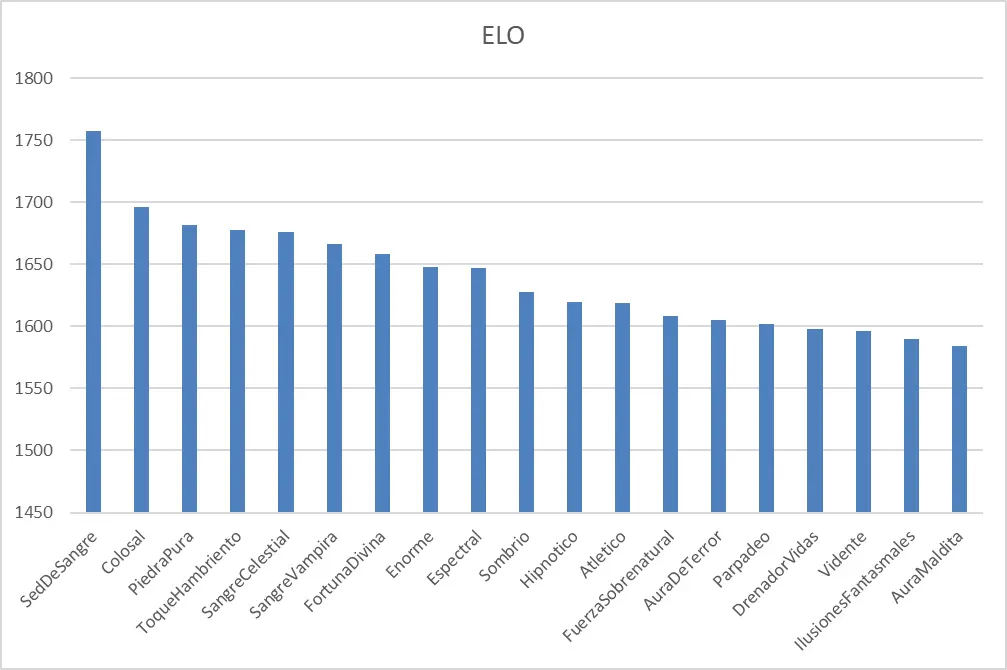 * Graphical representation of the top 20 traits by ELO.
When ranking by ELO, the winner is "Bloodthirst".
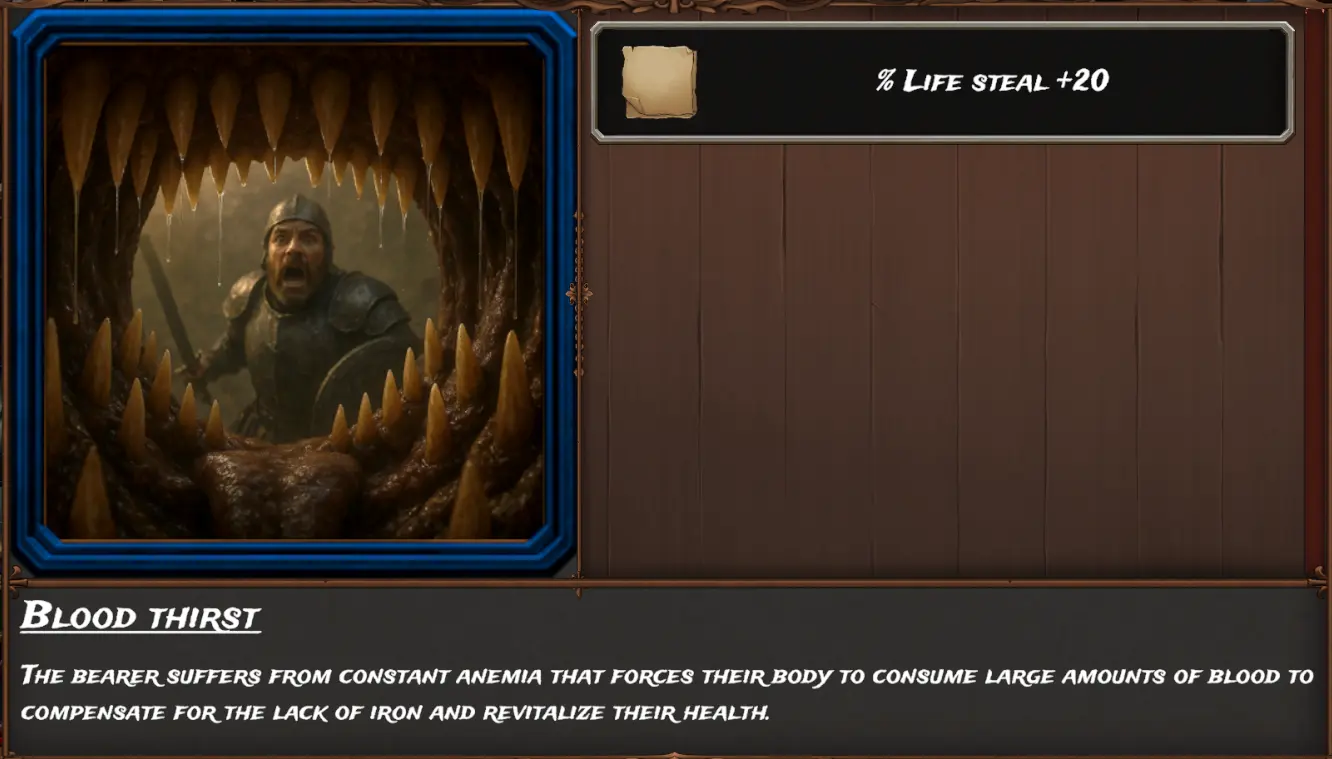
With this measurement method, we can see that although "Cursed Aura" was selected 100% of the time, the three times it appeared, it was chosen over traits with relatively low ELO; therefore, its rank increased, but not by much.
In other words, this system rewards traits that, even if they appear less frequently, are selected over traits that—by the luck of the draw—have appeared and been selected more often.
However, as many of you may have already thought: Wouldn't it be better to rank them by rarity? After all, traits of different rarities almost never appear together in the selection pool—though it's true this can happen when "evolving" a trait into its superior version. That is why we are now going to repeat the exercise from Section 2, but broken down by rarity.
3. Common Ranking
We will start by ranking common traits only
3.1 Common Ranking - Selection Count
If we look solely at the Selection Count for common traits, the ranking is as follows:
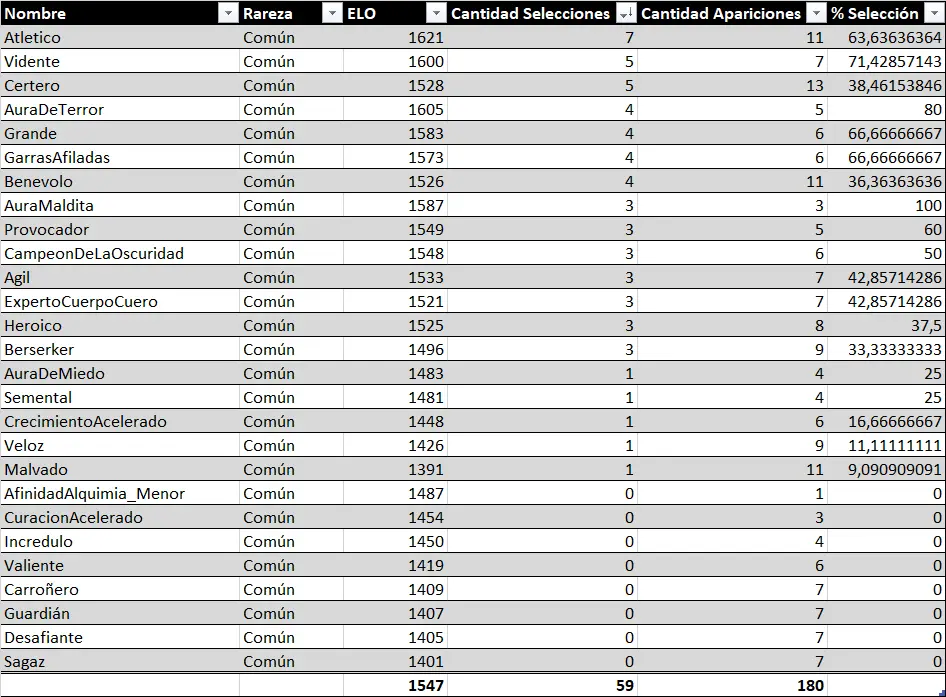
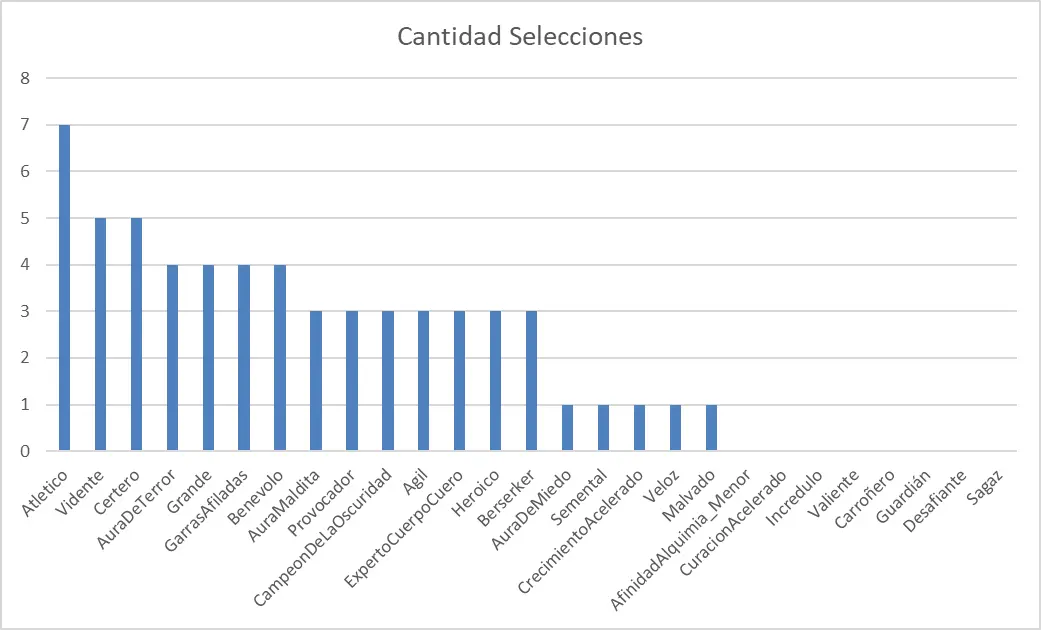 * Graphical representation of the Selection Count for ALL common traits.
According to this measurement method, the winner is "Athletic"

It is a common trait that appears quite frequently and grants us several distributed buffs; it's only natural that it has been selected so many times.
3.2 Common Ranking - Selection Percentage
Now, let's rank the common traits by Selection Percentage.
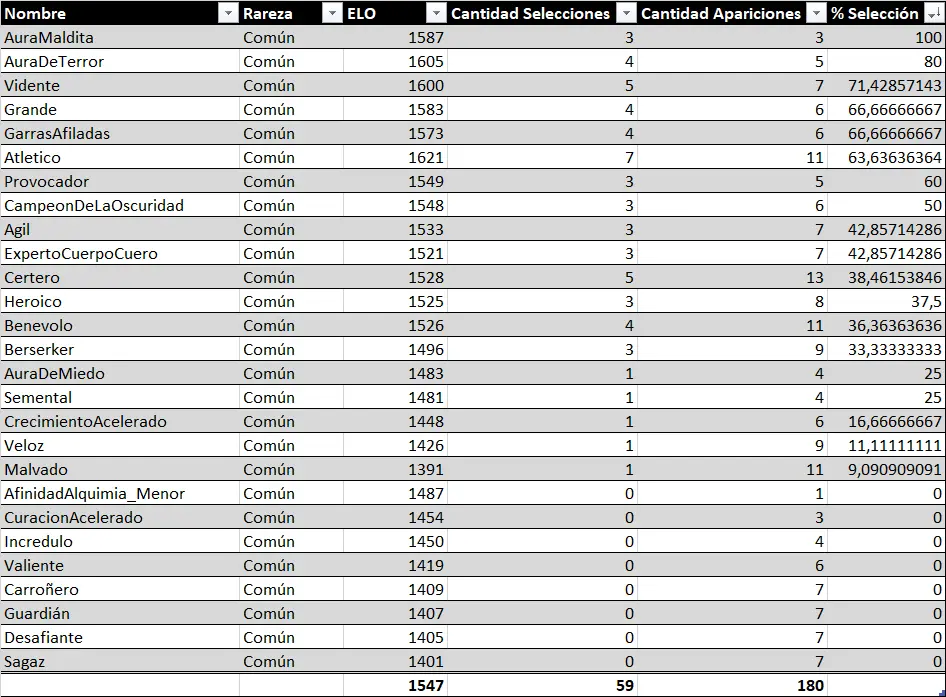
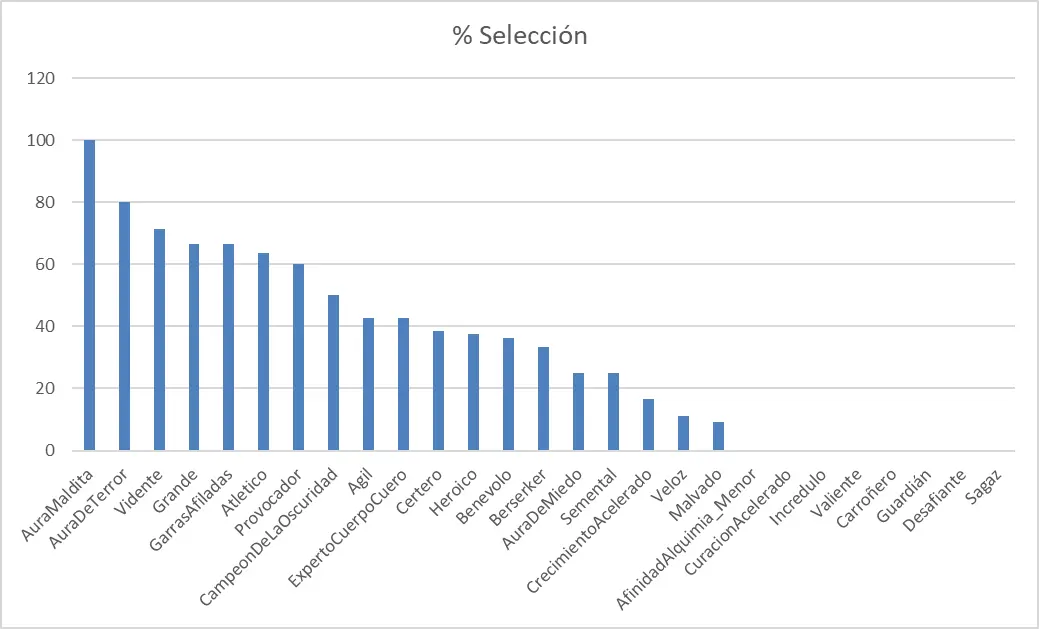 * Graphical representation of the selection percentage for ALL common traits.
Measuring it this way, the winner—as we already suspected from the previous ranking—is "Cursed Aura".
Since "Cursed Aura" has only appeared 3 times, and all 3 times it was chosen, it once again ranks highest in percentage with 100%. This is a clear sign that our current data is too small of a sample size to conduct a truly definitive study... We will wait for the conclusion of "Partida Masiva" and "Por Equipos" to have a much larger data set.
3.3 Common Ranking - ELO
Now, once again, here is the common trait ranking using only ELO.
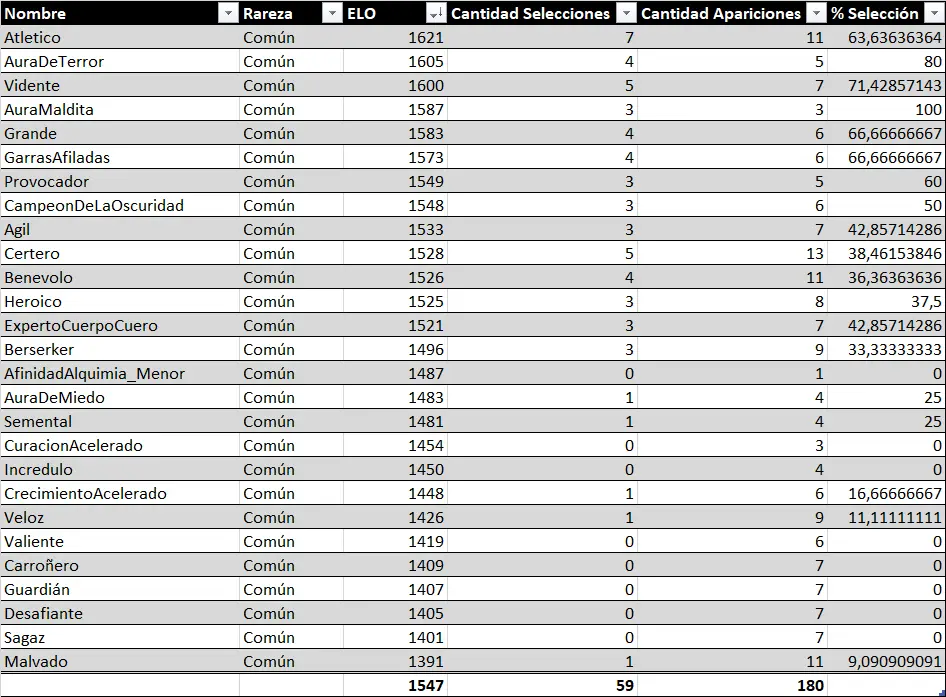
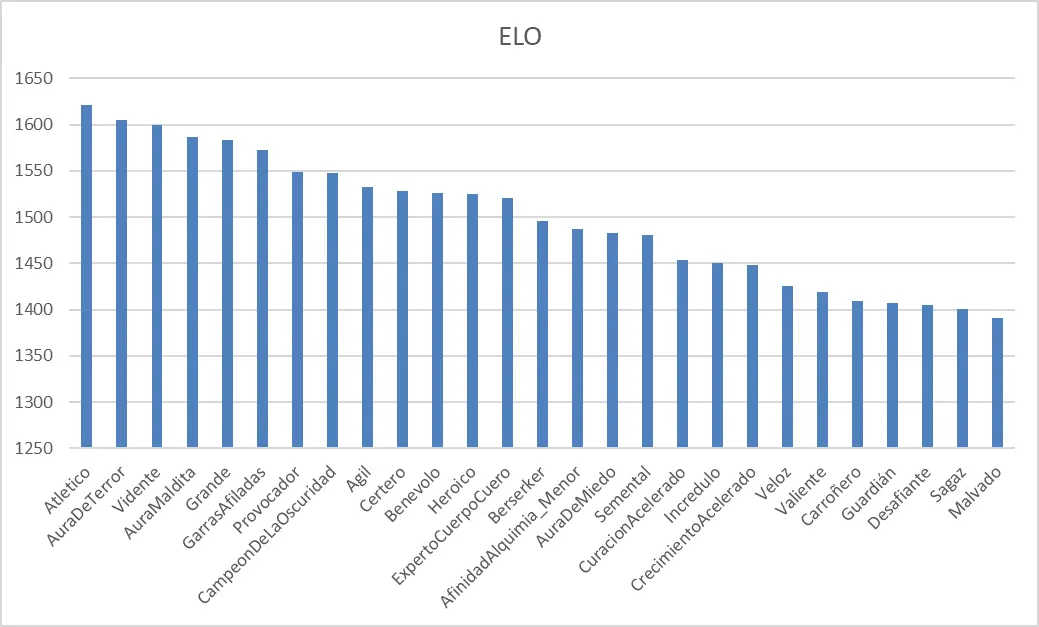 * Graphical representation of the ELO for ALL common traits.
Using this method, the winner is once again "Athletic".
4. Uncommon Ranking
We repeat the process, but this time considering only Uncommon traits ("NoComun" in the game code)—the ones with the green border.
4.1 Uncommon Ranking - Selection Count
If we sort them by Selection Count, this is the ranking:
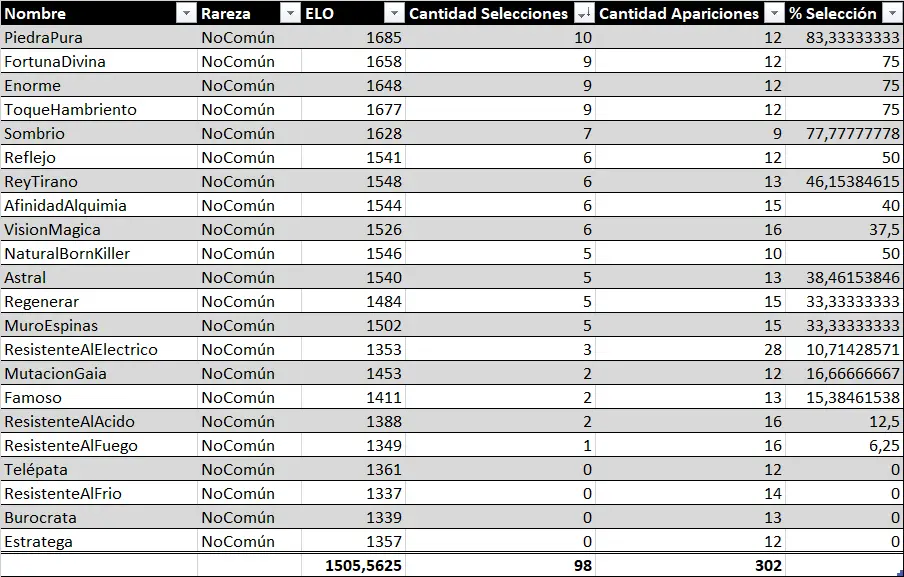
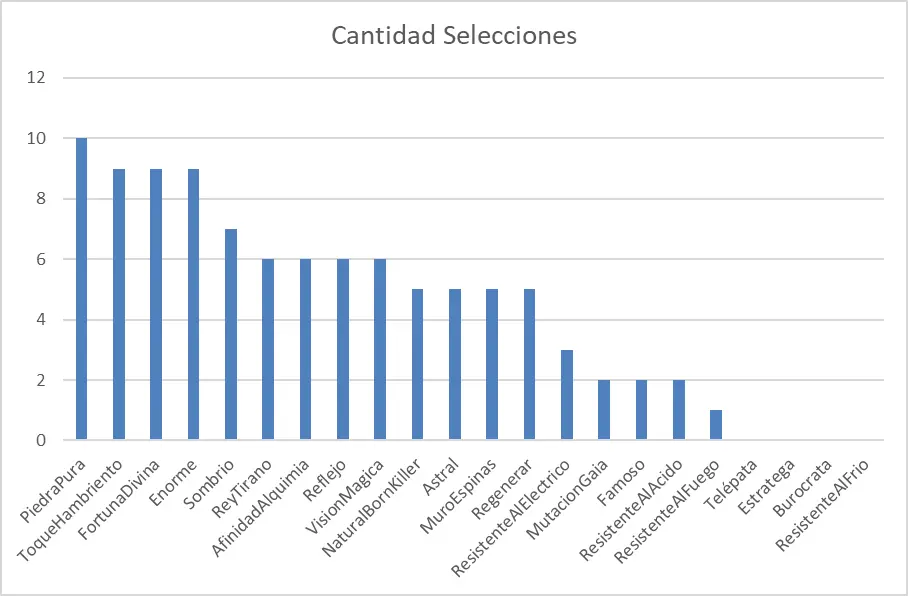 * Graphical representation of the Selection Count for ALL Uncommon traits.
Using this measurement method, the winner is "Pure Stone".
In this ranking, we once again have a textbook case: there is a three-way tie in Selection Count between three traits: Divine Fortune, Enormous, and Hungry Touch.

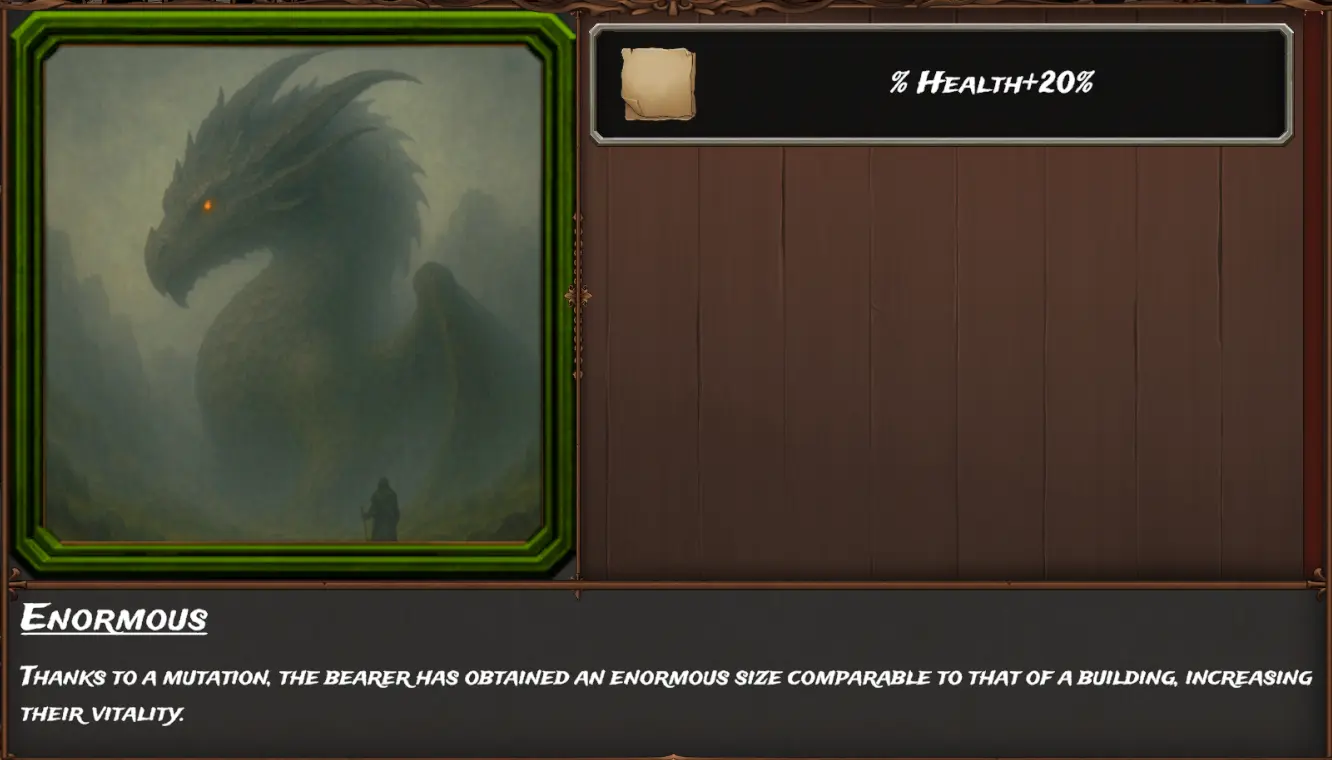

All three have been selected 9 times, so we don't actually know if any one of them is superior to the others. Let’s see if the Selection Percentage breaks the tie.
4.2 Uncommon Ranking - Selection Percentage
Now, we are going to sort the Ranking by Selection Percentage.
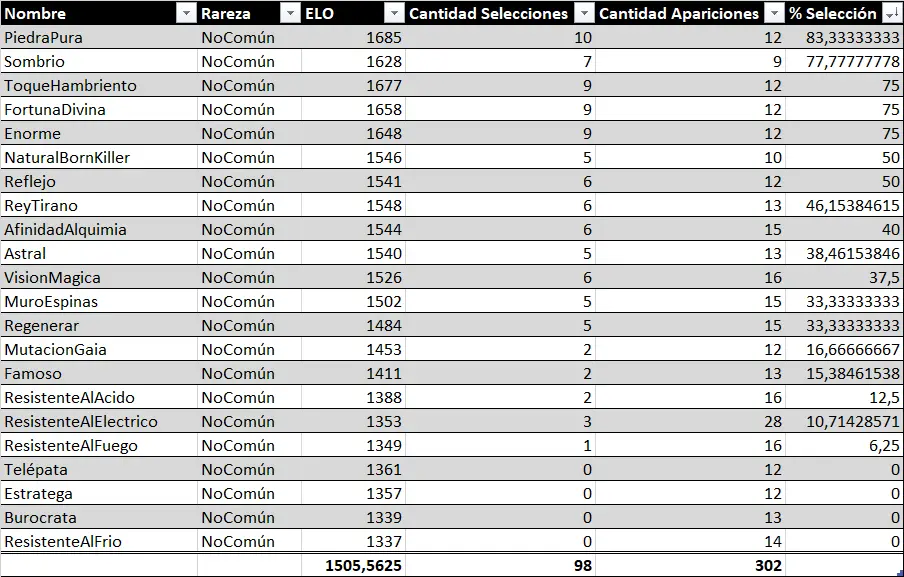
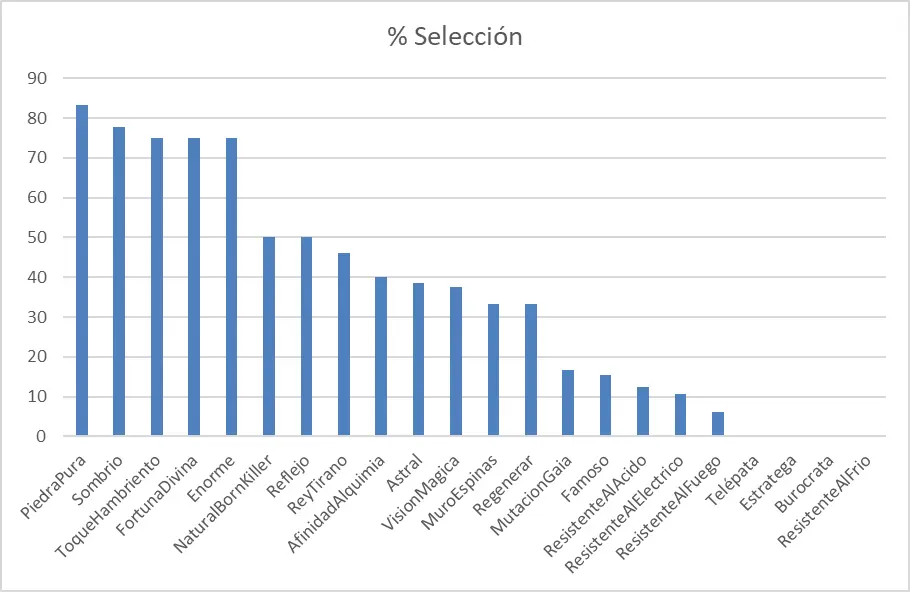 * Graphical representation of the Selection Percentage for ALL Uncommon traits.
With this method, the winner is still "Piedra Pura".
If we look back at the triple tie from the previous ranking, the tie persists: Hungry Touch, Divine Fortune, and Enormous were selected and appeared the same number of times, resulting in a 75% Selection Percentage for all three.
4.3 Uncommon Ranking - ELO
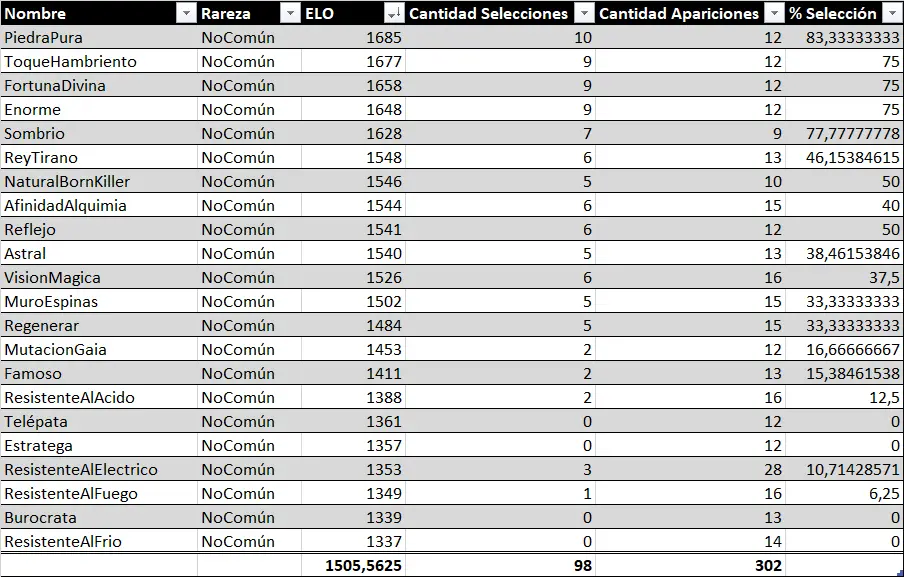
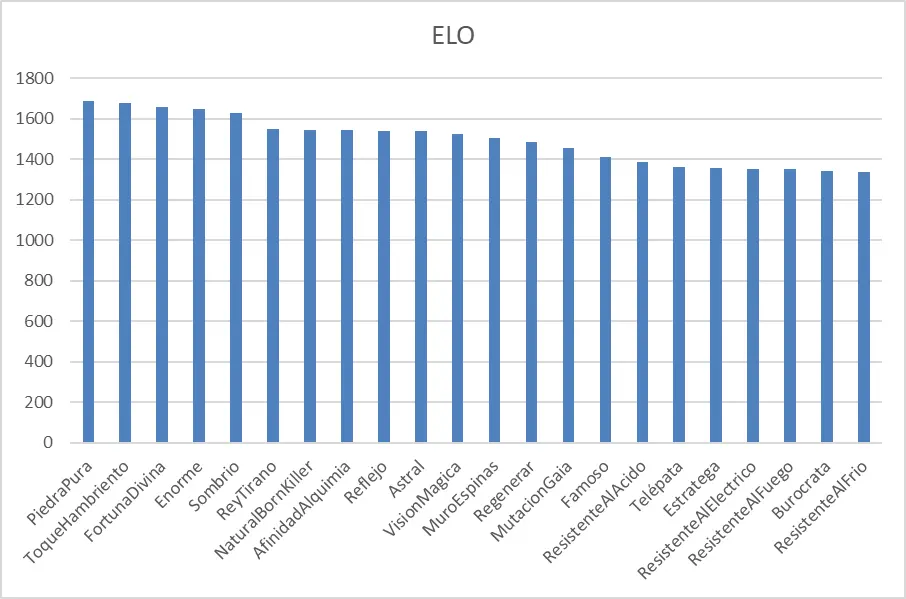 * Graphical representation of the ELO ranking for ALL Uncommon traits.
Finally, by looking at the ELO ranking, the triple tie is broken. Thanks to the ELO system, we can see that "Hungry Touch" is more highly valued by players than "Divine Fortune", which in turn is more highly valued than "Enormous". Even though all three have the same Selection Count and the same pick rate, "Hungry Touch" was selected over traits with higher value than those defeated by "Enormous" and "Divine Fortune".
5. Rare Ranking
Now, we will perform the ranking considering Rare traits only.
5.1 Rare Ranking - Selection Count
Once again, we will rank them by the number of times selected (Selection Count).
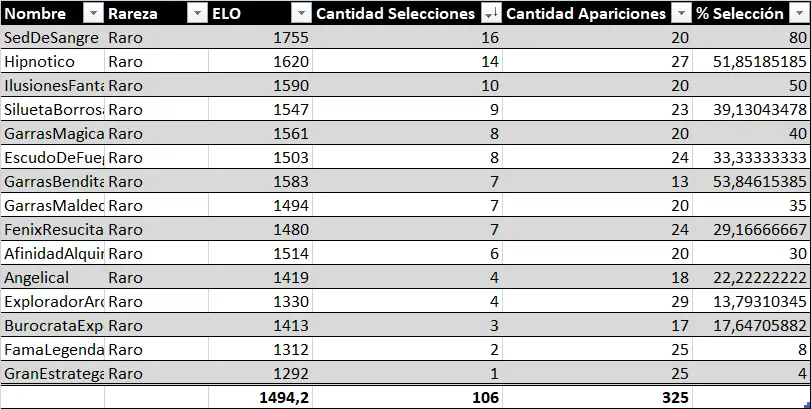
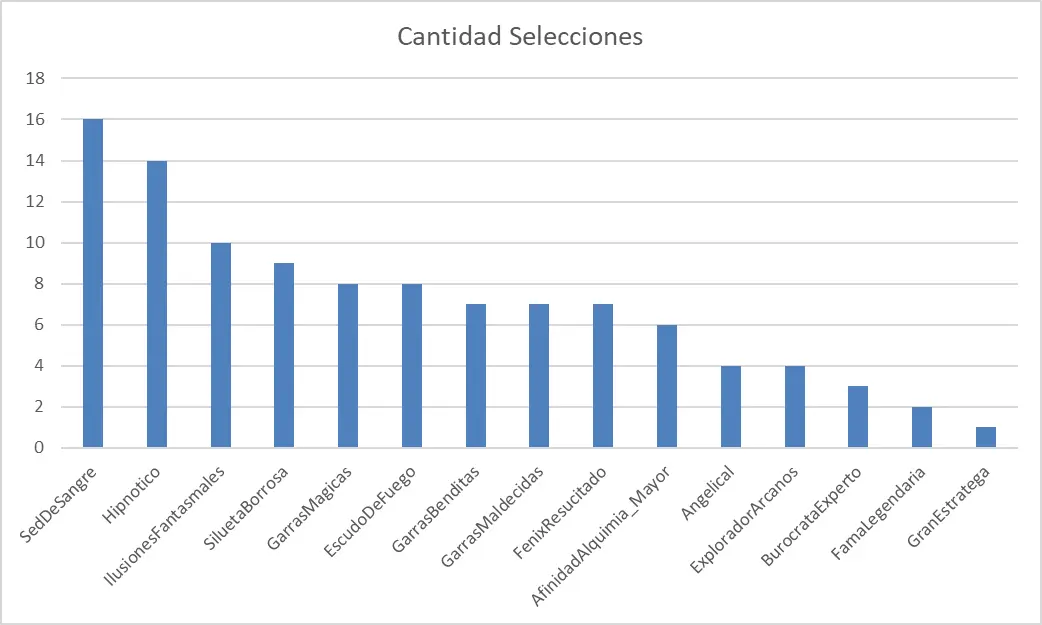 * Graphical representation of the Selection Count for ALL Rare traits.
In this case, we can see that the winner is "Blood thirst".
5.2 Rare Ranking - Selection Percentage
Now, we are going to sort them by Selection Percentage.
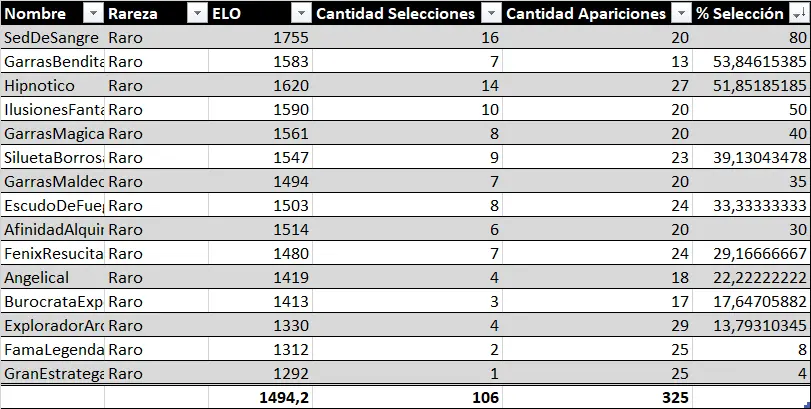
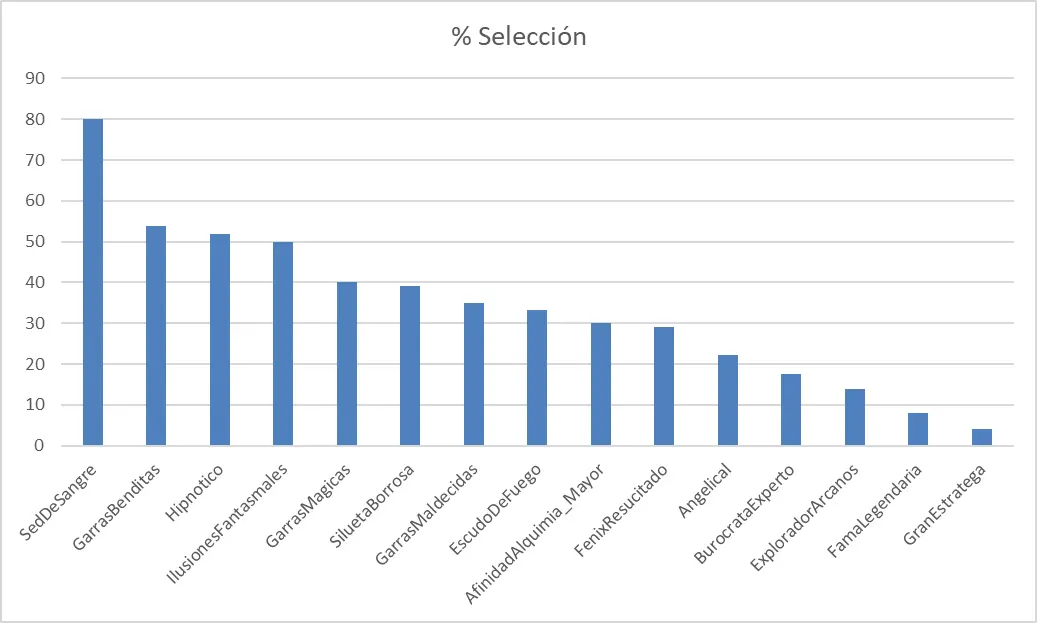 * Graphical representation of the Selection Percentage for ALL Rare traits.
In this case, "Bloodthirst" is still winning by a significant margin.
5.3 Rare Ranking - ELO
Finally, we will perform the ELO ranking.
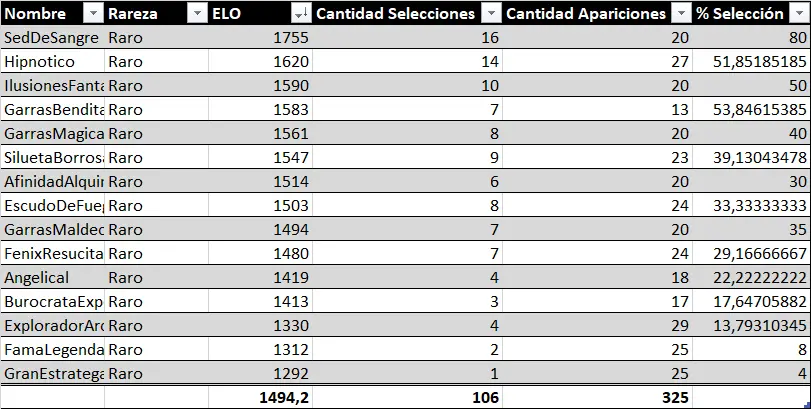
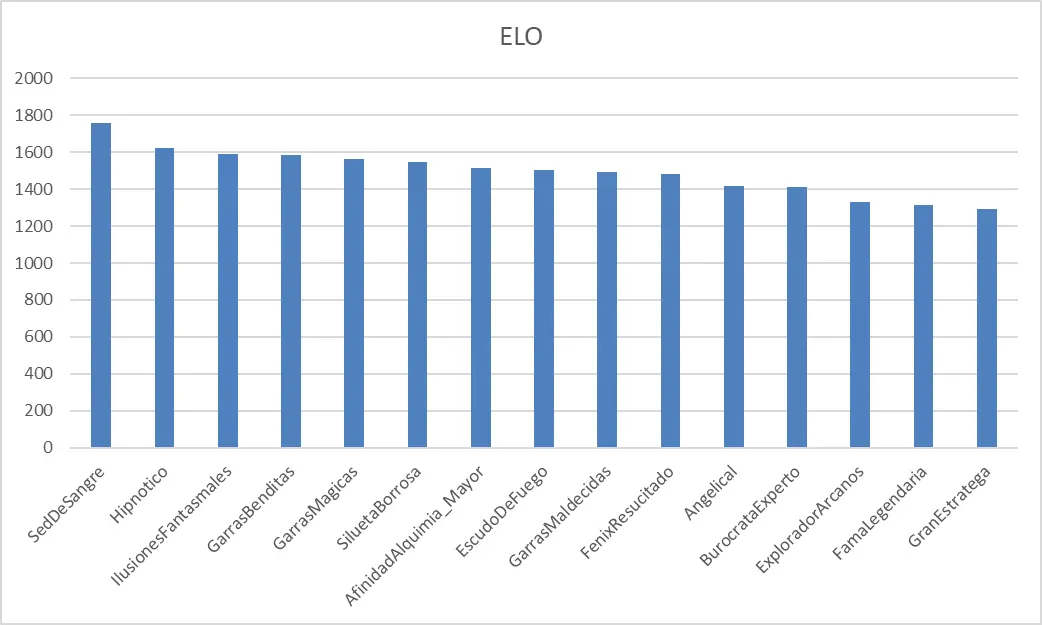 * Graphical representation of the ELO ranking for ALL Rare traits.
In this case, "Bloodthirst" remains the winner, and it appears to be the undisputed leader of the "Rare" tier.
6. Epic Ranking
Things are starting to get more interesting! Let’s take a look at the ranking for Epic traits.
6.1 Epic Ranking - Selection Count
As always, we’ll start with the Selection Count.
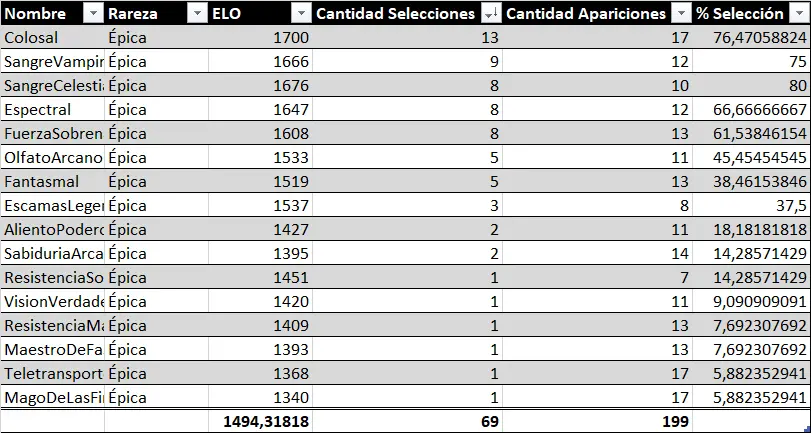
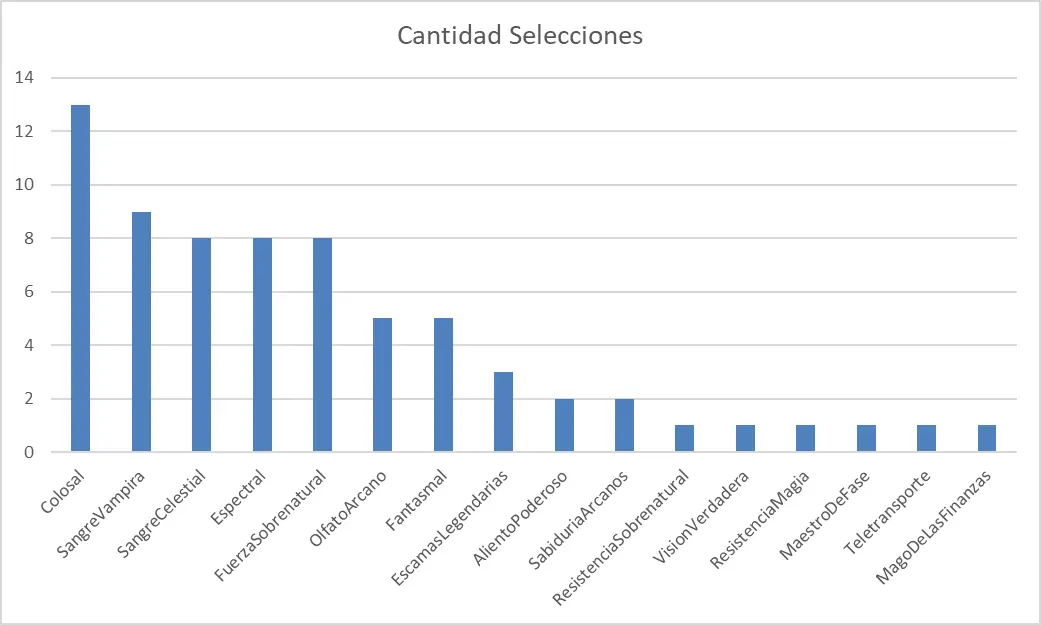 * Graphical representation of the Selection Count for ALL Epic traits.
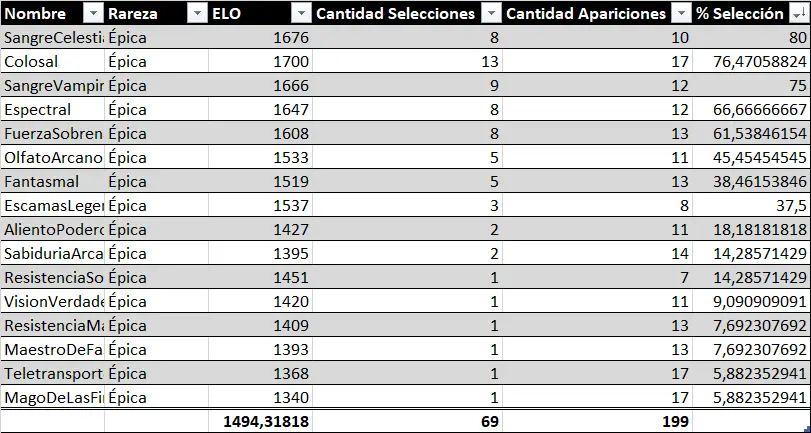
Using this method, the undisputed leader is "Colossal".
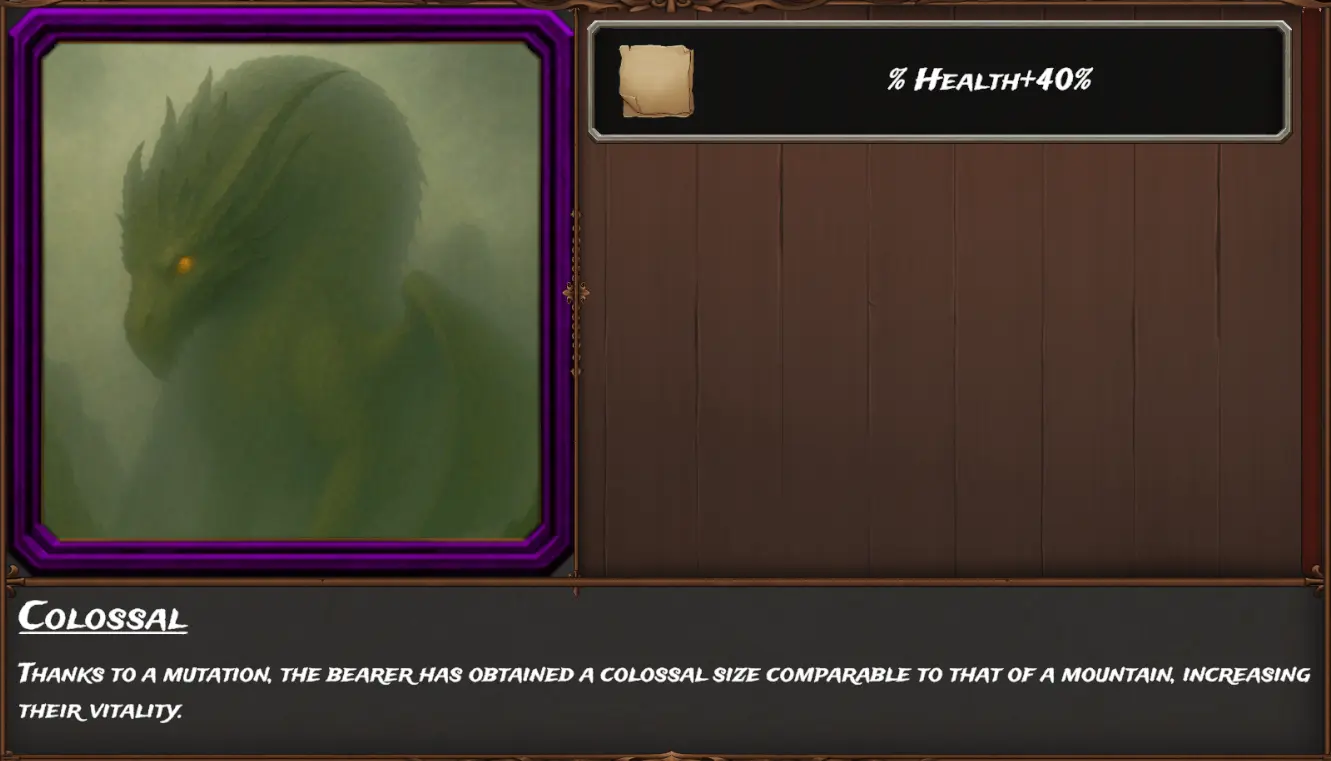
"Colossal" has the advantage of belonging to an upgradeable family, making it easier to reach. This explains why it appears more frequently and why it is the most common Epic trait offered, appearing a total of 13 times.
6.2 Epic Ranking - Selection Percentage
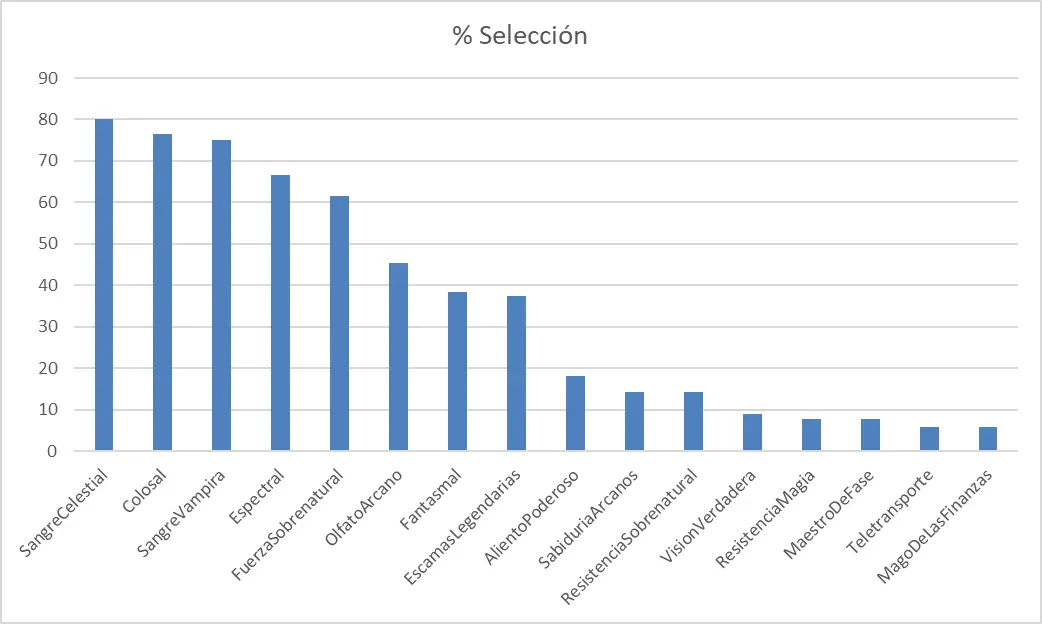 * Graphical representation of the Selection Percentage for ALL Epic traits.
Using this ranking, the undisputed leader is "Sangre Celestial".
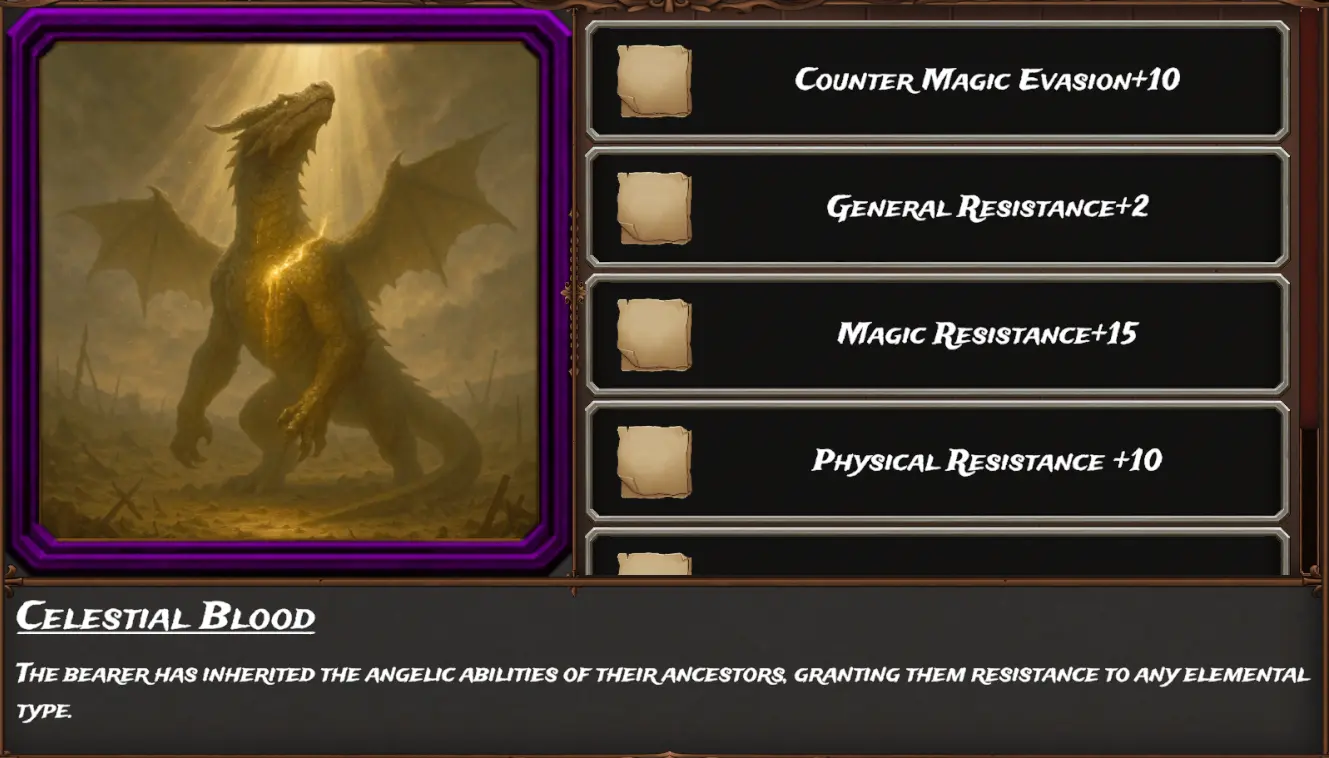
As a result, "Celestial Blood" appears less often but is chosen much more frequently than "Colossal" whenever it shows up.
6.3 Epic Ranking - ELO
Finally, let’s see if the ELO ranking can clarify once and for all which of the two traits is better: "Celestial Blood" or "Colossal".
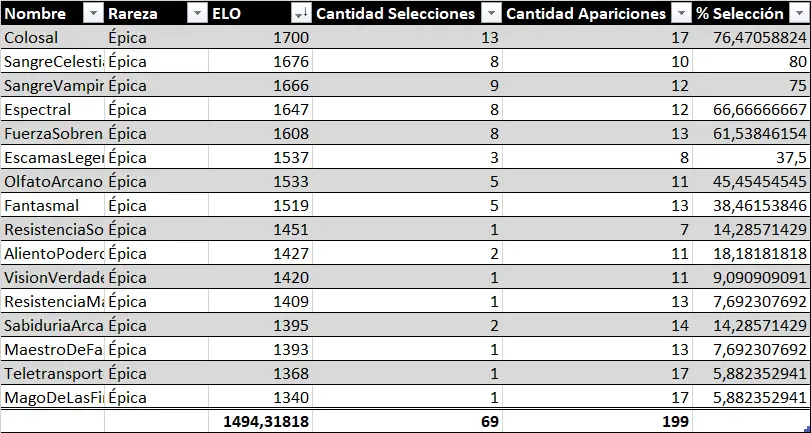
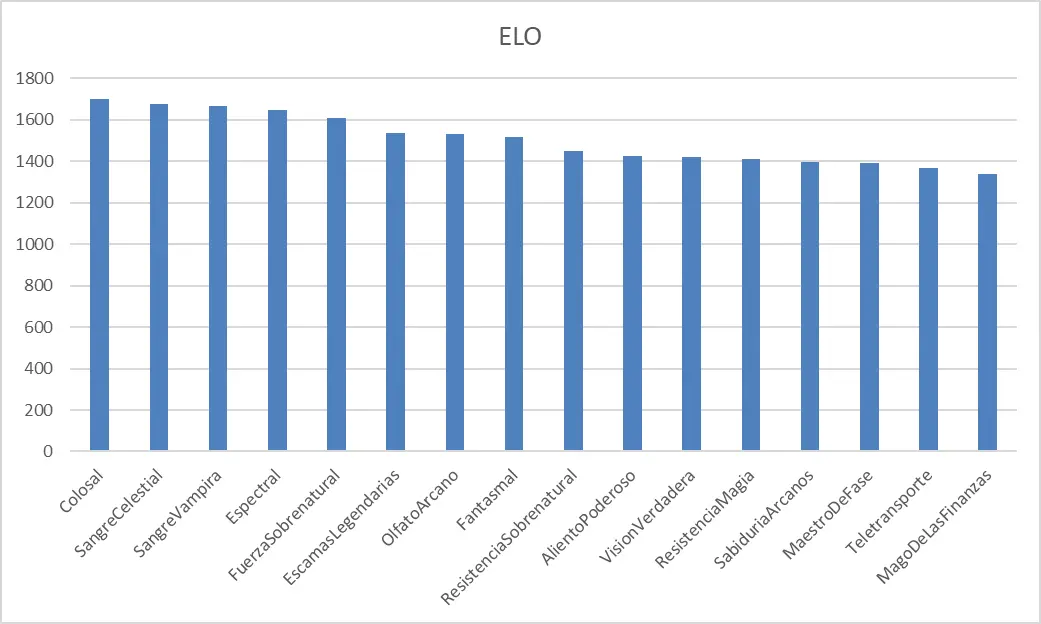 * Graphical representation of the ELO for ALL Epic traits.
It appears that, ultimately, player decisions suggest that "Colossal" is generally preferred over "Celestial Blood"—though this might be because "Colossal" is so common that it has managed to "farm" some ELO. We must take into account that "Colossal" has appeared practically twice as many times as "Celestial Blood". Everything points to the fact that, had both traits appeared the same number of times, "Sangre Celestial" would be the winner.
7. Unique Ranking
Finally, we enter the big leagues—the last category, the Unique traits:
7.1 Unique Ranking- Selection Count
As always, we’ll start with the Selection Count.

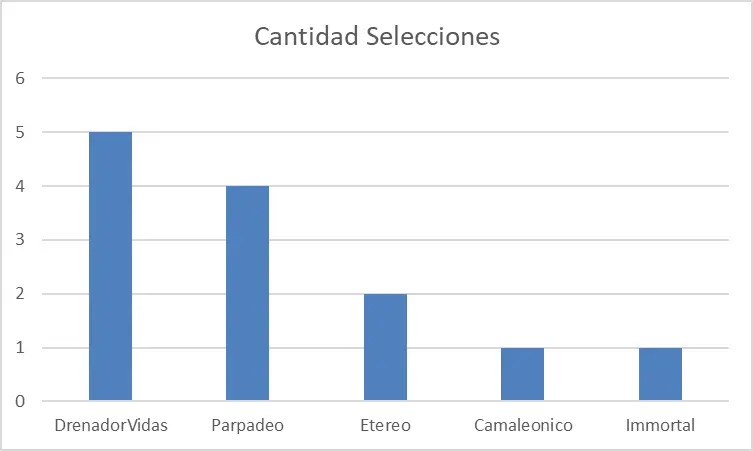 * Graphical representation of the Selection Count for ALL Unique traits.
Since these traits are so rare to encounter, the winner is "Life Stealer" with only 5 selections.

7.2 Unique Ranking - Selection Percentage
Now, as usual, let’s look at the ranking by Selection Percentage.

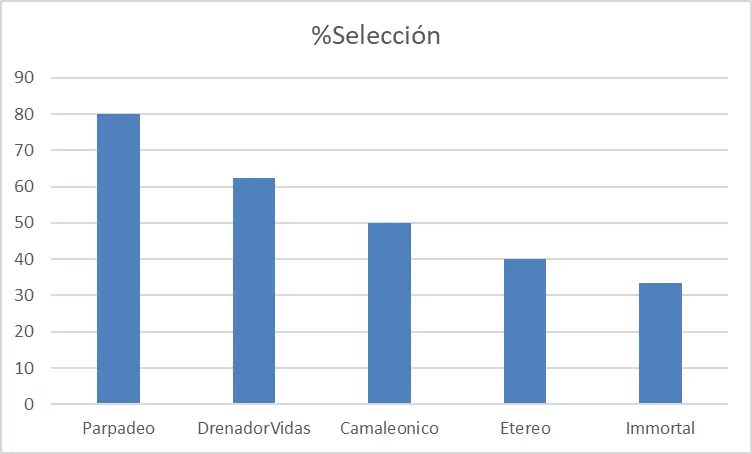 * Graphical representation of the Selection Percentage for ALL Unique traits.
In this case, the undisputed winner is "Blink".

It is worth noting that "Life Stealer", "Blink", and "Ethereal" are the traits with the most appearances because all three belong to upgradeable families.
7.3 Unique Ranking- ELO
Finally, let’s take a look at the ELO ranking for Unique traits.

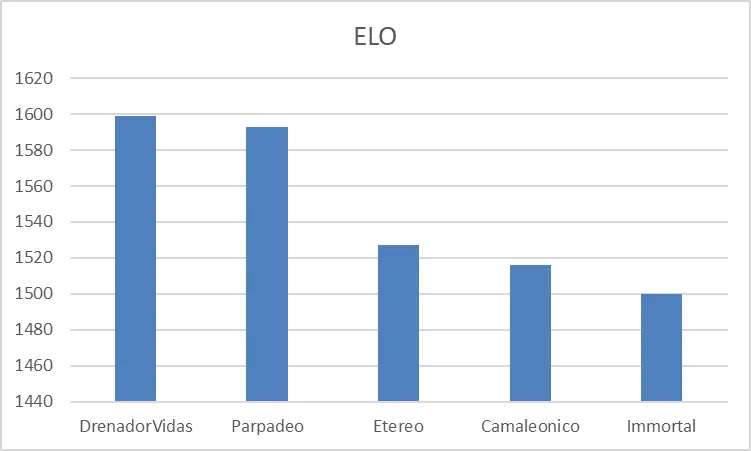 * Graphical representation of the ELO ranking for ALL Unique traits.
In this case, the undisputed winner is "Life Stealer".
8. Rarity Drop Rates
In this section, we are going to answer the question: Which trait rarity appears most frequently? Logically, one would think that "Common" or "Uncommon" traits should be the most frequent, not just because of their names but because of their power levels. But no... Once again, the reality of Cladia presents situations beyond the understanding of most mortals.
Paradoxically, the most common rarity is "Rare"—the traits with the blue border.
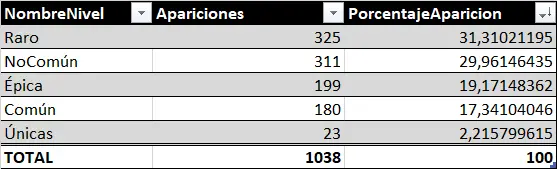
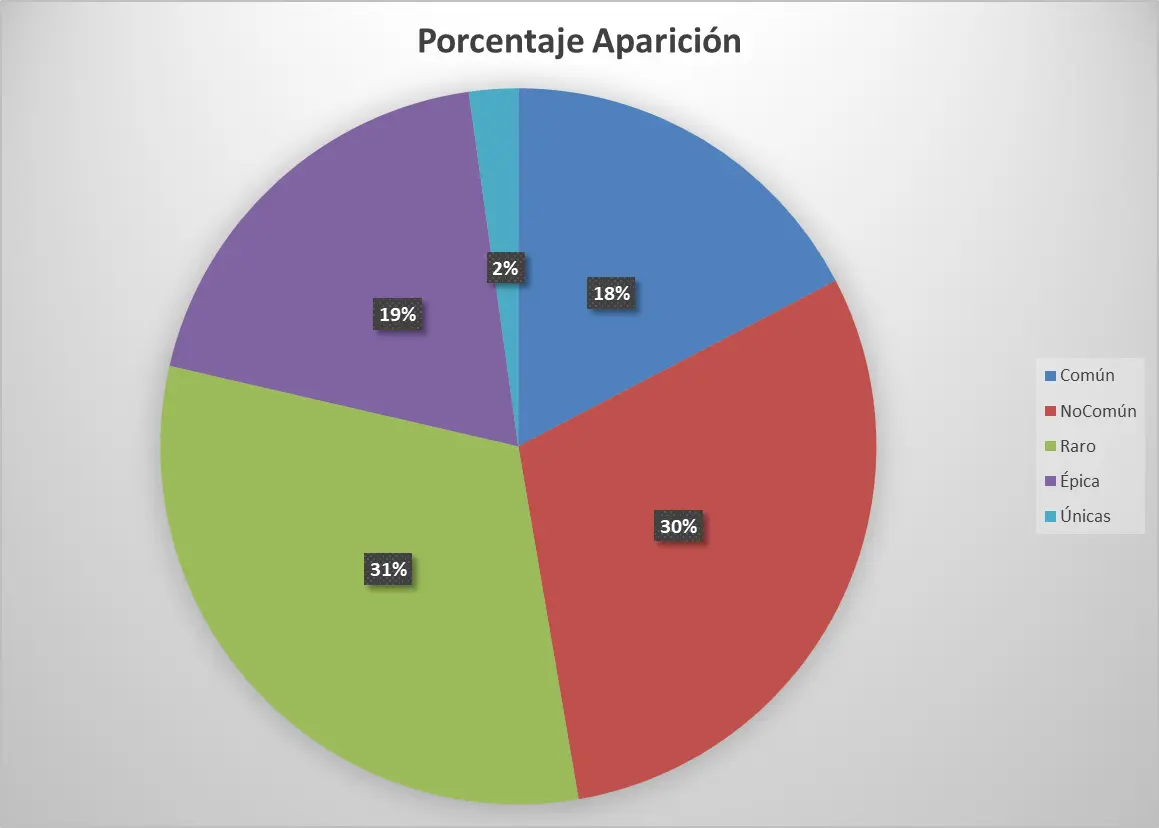
To clarify, the order would be:
- Blue Border (Rare)
- Green Border (Uncommon)
- Purple Border (Epic)
- Grey Border (Common)
- Gold Border (Unique)
To give you an idea: Common traits appear less often than Epic traits (the ones with the purple border).
9. Conclusion
That’s all for today, Alchemists! What did you think of this meta-analysis? Did you expect these results? Did your favorite trait make it into any of the top rankings?
You can leave a comment below to share your thoughts!
- Autor:Admin
- Publicado:28/03/2026 11:15:46