
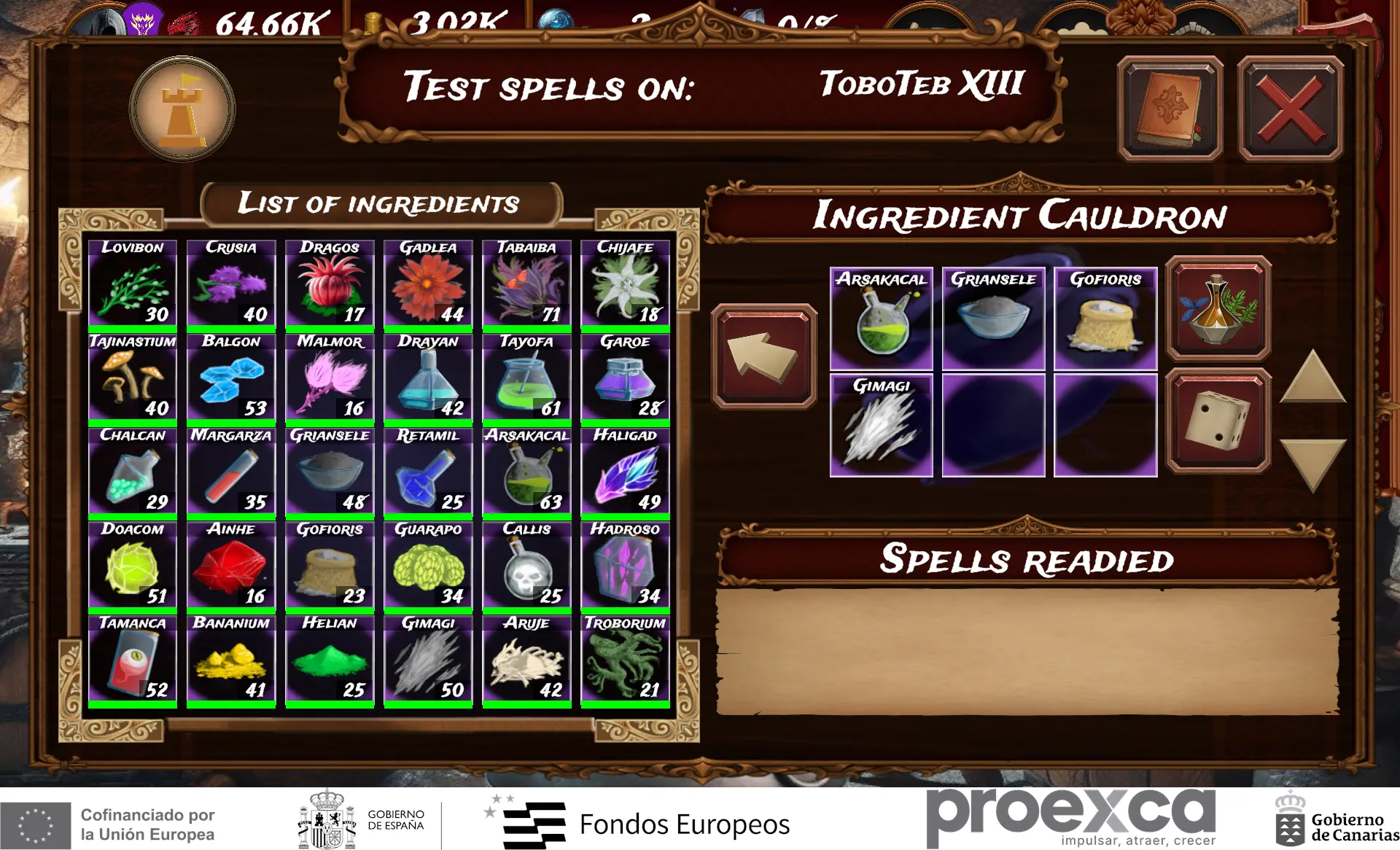
Until now, experiments have been basically “free”: you feed a brew to a dragon and nothing happens unless you happen to discover a real alchemical spell. In future versions, experimenting can have risks and rewards. Here’s the idea:
What is an Experiment?
An experiment is a combination of ingredients:
-
You use N ingredients (minimum 2).
-
No repeated ingredients in the same mixture.
-
NEW: the result can give a bonus (good) or a malus (bad).
Why is every match different?
Because at the start of each match, the game randomly generates two internal tables:
-
Effect Table
This decides what bonus/malus each ingredient combination produces.
Example: 3 Attack, -2 Defense, etc. -
Reactivity Table
This decides whether the mixture is stable or powerful. It’s a multiplier that can:
-
Cancel the result (if it’s 0 → the experiment does nothing)
-
Keep it similar (near 1)
-
Boost it (greater than 1)
-
Even invert it (negative values can turn a bonus into a malus, or the other way around)
So in one match, a mixture can be amazing… and in another match, that exact same mixture can be mediocre or even bad. That’s the fun: experimenting can bring a reward… or a punishment. You’re discovering, taking risks, and if you hit something spectacular, you keep it.
Memorizing discoveries
If you find an especially strong mixture, your alchemist can memorize it as a special spell for that match.
Normal spells still exist—this is an extra layer to make the Lab useful throughout the whole game.
Simple example: “Dragon Attack bonus”
Imagine you run an experiment with 4 ingredients:
Mixture: A D E F
The game evaluates two things:
-
Base effect
-
Dragon Attack bonus: 3
Meaning: if applied to your dragon, its Attack stat increases by 3.
-
Reactivity (multiplier)
-
Reactivity: x2
So the final result is boosted: -
Final Attack bonus = 3 × 2 = 6
✅ Final experiment result: “Dragon Attack bonus: 6”
And here’s where it gets interesting:
-
If reactivity was 0, the experiment would be canceled (no bonus, no malus).
-
If reactivity was -2, the bonus becomes a malus: 3 × (-2) = -6 (Attack would drop).
What do you think? It might sound complex at first, but our goal is simple: make the Laboratory ALWAYS useful—either as a steady tool, or as a “desperation play” when you need a miracle.
- Autor:Super
- Publicado:02/03/2026 23:22:19