
Greetings, Alchemists!
The latest update introduced a change... experimentation can now have unexpected effects, both negative and positive. In this FAQ, we will try to break down this change in mechanics. If you are new or have never read the original experimentation post,I recommend reading it first, because everything explained there remains the foundation of experimentation today. Here is the link to the original post.
Contents
- Ingredient Effects
- Possible Effects
- Reactivity Matrix
- Calculating Recipe Effects
- Discovering the Effects and Reactivity of Two Ingredients
- Conclusion
1. Ingredient Effects
The first thing to understand is that there is now an internal table, hidden from the player, in which each ingredient has between 0 and 5 possible effects. In the next section, we will see which effects are possible for each target. Yes, it is highly unlikely, but all 30 ingredients could have 5 effects, or none at all.
Each effect of each ingredient is also assigned an internal value from -8 to 8. These are whole numbers, without decimal places. Effects are added together when ingredients are combined.
In case there was any doubt, these effects, like spell recipes, are randomly assigned once at the start of each game.
2. Possible Effects
Now that we know this, let's look at the possible effects for each target.
We will also include the MAXIMUM value achievable with the perfect combination.
No higher value is possible. Even if you find a combination exceeding it, the game caps the value at the limit shown in this section.
Yes, the limit is symmetrical. If the maximum concentration gain is 3, the minimum is also -3 concentration. Unless stated otherwise, the minimum is therefore the maximum with its sign reversed.
2.1. Settlements
- Civilization: 7
- Trade: 7
- Growth: 7
- Militarization: 7
- Health: 7
2.2. Eggs
- Brilliance: 10
- Anomalies: 10
- Health: 10
- Mutability: 10
- Twins: 100
- Heat per Turn: 100
2.3. Alchemist
- Permanent Concentration: 3
- Transform Ingredients into Gold: 1000
- This effect also has a minimum of 0, so we can never lose gold through experimentation.
- Mercenary Appearance: 30
2.4. Dragons
- Strength: 10
- Resistance: 10
- Accuracy: 10
- Evasion: 10
- Health Points: 10
- Intelligence: 10
- Breath: 8
- This effect also has a minimum of 0. If we find a combination that reduces Breath damage, it will actually add 0, so we will not know whether it is reducing Breath or whether the combination simply had no effect.
- Age: 100
- Note: if a dragon's age decreases, returning to an age it has already reached does not grant the age bonuses again. The dragon retains all its base stats, Breath damage and scale protection as though its age had not decreased. When aging again, it only gains bonuses for ages it has never reached before.
Paradoxically, this provides a better disguise than the "Old Glory Disguise" and "Ember Disguise" spells.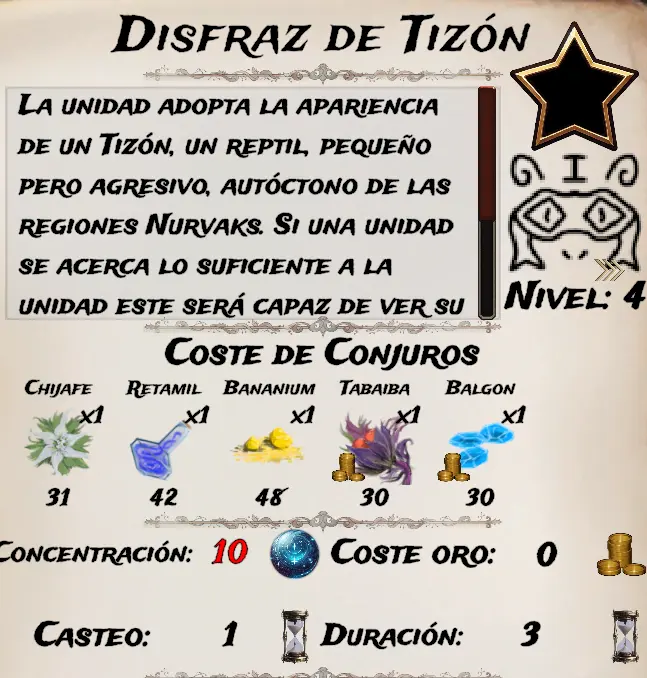
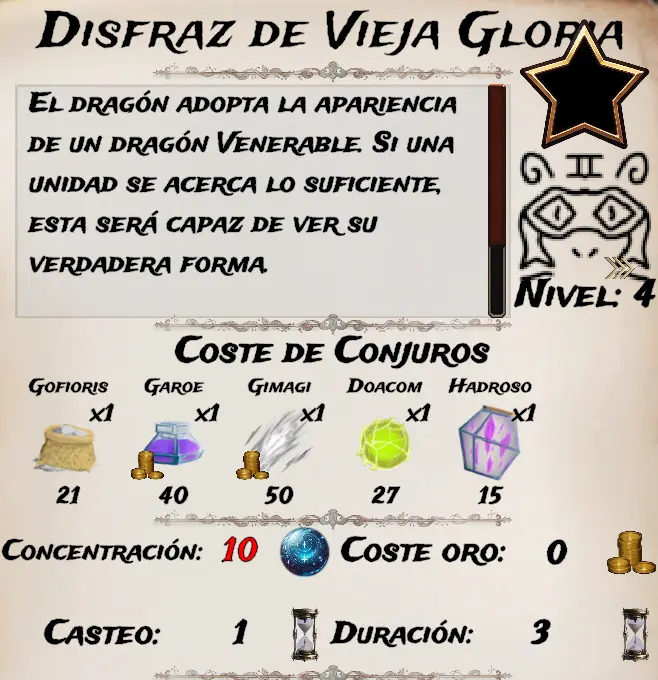
For newer players, these spells let you "change" a dragon's age, at least in appearance. Dragons retain everything, and when they enter combat they "lose" the disguise and reveal their real age. The problem with these disguises is that they always show the same age, which also does not change when the turn advances. More observant alchemists could therefore identify which dragons are disguised. Reducing their real age, however, means the age shown to the opponent need not match the disguise's fixed age and will change each turn, making it much better than disguise spells.
- Note: if a dragon's age decreases, returning to an age it has already reached does not grant the age bonuses again. The dragon retains all its base stats, Breath damage and scale protection as though its age had not decreased. When aging again, it only gains bonuses for ages it has never reached before.
As you have seen, for the first time in Cladia's history there is a recipe that can increase a dragon's health, although it adds at most 10 base points (40 actual points) each time we cast the spell. Anyone who found that magical recipe would be especially dangerous.
3. Reactivity Matrix
Before everyone starts frantically mixing ingredients in their cauldrons to find a recipe that ages a dragon by 100 years and adds 10 base health, let's explain ingredient reactivity. It will probably make discovering that perfect recipe practically impossible.
At the start of the game, besides distributing the effects described in the previous section among the ingredients, reactivity values between ingredients are also randomly assigned. It sounds complex, but essentially we create every ingredient pair without considering order: Gofioris - Tabaiba is the same as Tabaiba - Gofioris. Each pair has a 2% chance of receiving a value within the ranges [-3, 0.98] [1.02, 3]. Only 0.99, 1 and 1.01 are avoided, to exclude 1 or similar results. If the 2% chance does not trigger, the reactivity is set to 1.
Then 14 random pairs are selected, and their reactivity is manually set to 0. Every game therefore has at least 14 combinations with a value of 0, but there may be more, since, as stated in the previous paragraph, 0 is a valid reactivity value.
Finally, 2 random pairs other than those set to 0 are selected and assigned a reactivity of 8.
4. Calculating Recipe Effects
Now that we know the possible effects and the reactivity matrix, how is an experiment's final effect calculated?
Essentially, we form every pair, ignoring order: A - B is the same as B - A. We multiply the reactivity values of all the pairs together. As soon as we encounter a reactivity of 0, the total becomes 0, and the experiment has no effect.
To illustrate, putting 2 ingredients in the experimentation cauldron gives us just one pair, so there is only one reactivity value. The experiment's reactivity is simply the reactivity between A and B. With 3 ingredients, however, we have the reactivities of A-B, A-C and B-C, and multiply all 3 together.
The following table shows how many reactivity values are involved in a recipe for each ingredient count.
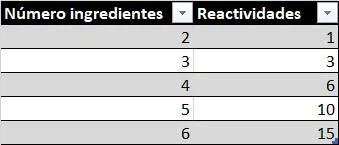
As we can see, the more ingredients we add, the more likely we are to encounter a reactivity of 0 and ruin the experiment.
Once reactivity has been calculated, we look at the possible effects on the experiment's target and each effect's value. Remember that this is what we covered in section 1: an effect with a value between -8 and 8.
We then multiply the reactivity by the value of each possible effect on that target.
For example, suppose we experiment with Tabaiba and Gofioris, and their reactivity is 2.71.
Tabaiba's effects are 8 concentration for the alchemist and -5 Brilliance for the egg.
Gofioris's effects are -2 concentration for the alchemist, 2 Twins for the egg and 7 Strength for the dragon.
If we experiment with Tabaiba and Gofioris in the laboratory, we add the effects on the alchemist: 8 minus 2, giving 6. We then apply reactivity: 6 times 2.71 is 16.26. Finally, we apply the target's maximum, which in this case is 3. The final result is therefore 3.
If we experiment with Tabaiba and Gofioris on an egg, we get -5 Brilliance and 2 Twins, because an ingredient with no effect on a target contributes 0. Applying reactivity gives -5 times 2.71, or -13.55 Brilliance, and 2 times 2.71, or 5.42 Twins. We then apply the target limits, leaving Tabaiba and Gofioris with a final effect of -10 Brilliance and 5.42 Twins on the egg.
What would happen if we added Aruje to the formula?
Aruje has a reactivity of 0 with Tabaiba, but -0.98 with Gofioris.
Aruje has no effects on any target. As we saw in section 1, each ingredient has between 0 and 5 effects.
Therefore, adding Tabaiba, Gofioris and Aruje cancels the experiment for both targets, and no effect occurs.
Combining Gofioris and Aruje, however, gives the alchemist (-2 times -0.98) 1.96 concentration and the egg -1.96 Twins.
One final example:
Instead of Aruje, suppose we add Bananium, which has a reactivity of 1 with Aruje and 8 with Gofioris. Imagine Bananium only grants 3 Brilliance.
The reactivity between the three ingredients is (2.71 times 1 times 8), or 21.68.
Using it on the alchemist would give (6 * 21.68) 130.08 concentration, but applying the cap leaves 3.
Using it on the egg would give (-5 plus 3 equals -2 Brilliance) (-2 * 21.68) -43.36 Brilliance and (2 * 21.68) 43.36 Twins.
As you can see, even finding the combination with a reactivity of 8 makes it difficult, though not impossible, to find a truly good combination...
5. Discovering the Effects and Reactivity of Two Ingredients
Unfortunately, this cannot currently be done using only the game. Our only option is to perform 1 experiment per target and record its characteristics externally before and after applying the experiment. In other words, trial and error, with many screenshots and handwritten notes, to rule out combinations and refine recipes...
Can you think of a way to present this in the game so that external tools are unnecessary? We would love to read your ideas in the comments.
6. Conclusion
What do you think of this new mechanic? It really is complex, and its presentation is still rough because the player receives little feedback.



Comments (0)
Leave a comment